Rahul Ramakrishna’s brother dies of paraquat poisoning; actor sends SOS to CM Revanth
Dr. Kadiyam Kavya, Member of Parliament from Warangal, stood up in parliament and put numbers to what clinicians across India have long been warning.
By - Newsmeter Network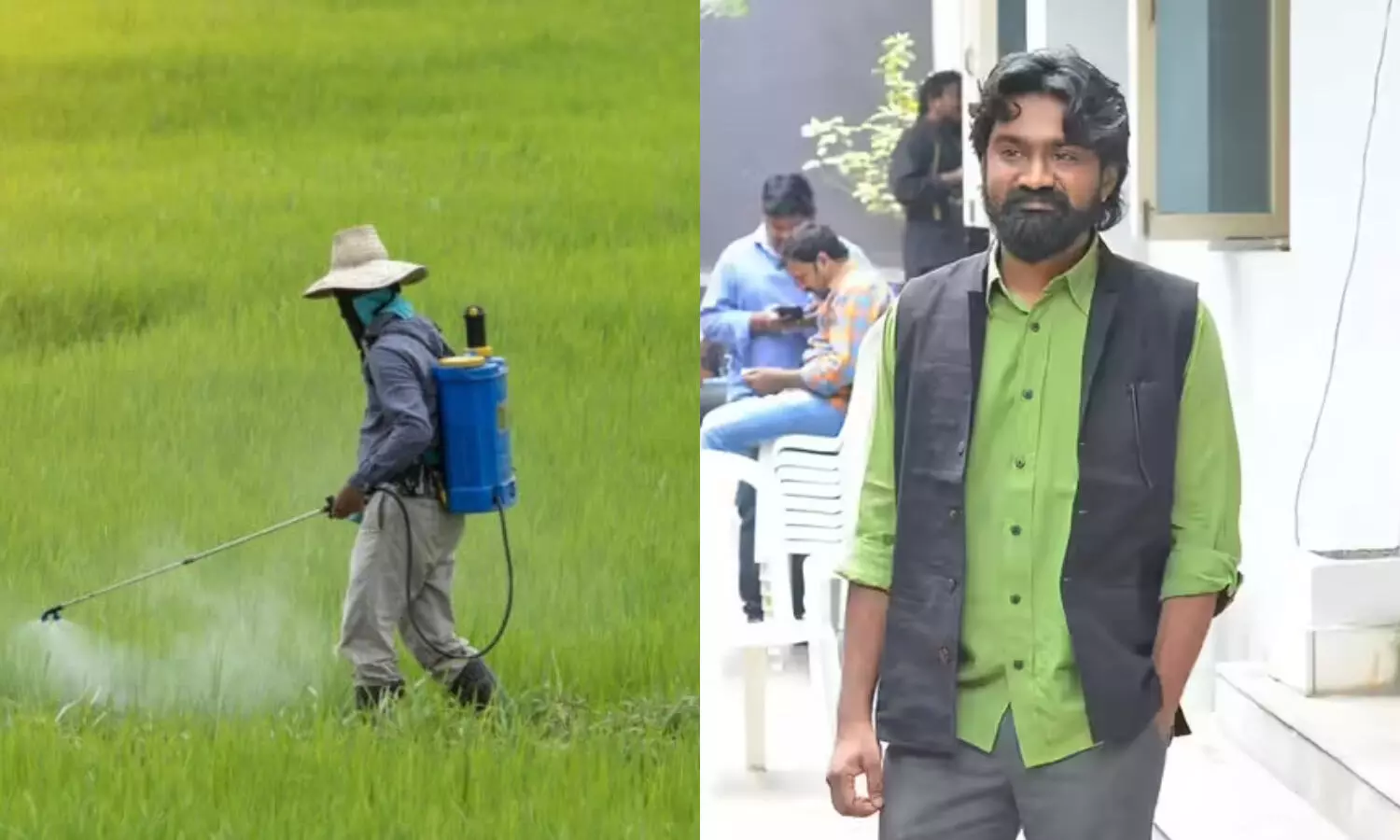
Hyderabad: On March 26, actor Rahul Ramakrishna, known for his roles in Arjun Reddy, Ala Vaikunthapurramuloo, and RRR, posted a message on X that stopped many of his followers cold.
"Lost my brother today to paraquat poisoning," he wrote, addressing the Telangana Chief Minister's Office and the Prime Minister's Office. "It's terrifyingly lethal and widely misused for self-destruction. Shocked by how easily it is available everywhere. Doctors are overwhelmed by the number of cases. Please ban it ASAP - save lives."
The grief was personal. But the problem, as doctors, researchers, and parliamentarians are now urgently pointing out, is national.
The next day, Dr. Kadiyam Kavya, Member of Parliament from Warangal, stood up in parliament and put numbers to what clinicians across India have long been warning.
"Paraquat dichloride is an internationally recognised, most acutely toxic herbicide. Even a minimum exposure can cause hazardous effects on the human body, including lung, kidney, and liver failure, and finally death. The sad thing is there is no antidote for this dangerous poison, which is frequently used by poor farmers," she said.
She urged the central government to impose a ban, noting that states have no power to do so permanently.
The scale of the crisis
A decade-long study from a quaternary care centre in South India, published in the Indian Journal of Critical Care Medicine in February 2026, analysed 166 paraquat poisoning cases between 2015 and 2024.
The findings were stark. Nearly 80% of patients did not survive. The median survival time was just five days. Cases rose exponentially over the study period, from a single case in 2015 to 53 by 2024.
The majority of patients, 65.7%, came from Andhra Pradesh. Kadapa and Chittoor districts alone accounted for three-quarters of those cases.
At Gandhi Hospital in Hyderabad, a parallel ten-year study of 400 patients referred for paraquat-related acute kidney injury found a mortality rate of 75%. Of 1,342 paraquat admissions over the period, approximately 30% developed acute kidney injury.
Together, the two studies represent the most extensive documentation of paraquat poisoning in southern India to date.
What paraquat does to the body
Paraquat is a non-selective herbicide approved in India as a 24% soluble liquid for use in nine crops. Once ingested, it initiates a cascade of destruction that medicine has almost no tools to reverse.
It accumulates in the lungs, triggering an inflammatory response that leads to irreversible fibrosis. Acute respiratory failure, renal failure, and liver injury follow rapidly. There is no specific antidote.
In the CMC cohort, acute kidney injury was present in 92.2% of patients. More than half developed lung injury. A grim clinical marker, ulceration of the oral mucosa known among doctors as "PQ tongue", was observed in nearly 40% of patients.
What makes paraquat uniquely dangerous beyond its toxicity is timing. The poison is rapidly excreted by the kidneys, 80 to 90% within six hours of ingestion.
Yet only 12.6% of patients in the CMC study reached the hospital within that window. Nearly half arrived after 24 hours, by which point the damage to organs is largely irreversible.
Who is dying, and why
The profile of victims is consistent across both studies. They are predominantly young men in their twenties and thirties, many of them farmers or employed workers, reaching for the nearest available means in a moment of acute distress.
In the CMC study, 97.6% of cases were deliberate self-poisoning. Family conflict was the single most common trigger, cited in 54.2% of cases, followed by financial stress.
At Gandhi Hospital, suicidal intent accounted for 90% of admissions. Of the 10% who consumed paraquat accidentally, many did so under the influence of alcohol.
Paraquat's accessibility is central to why it keeps appearing in these crises. It is cheap, widely stocked in rural agricultural supply shops, and until recently entirely unregulated at the point of sale.
"PQ is a readily available and unrestricted weedicide," the Gandhi Hospital authors noted plainly.
What doctors are seeing, and what little they can offer
A meta-analysis of 15 Indian case series conducted alongside the CMC study found a pooled mortality rate of 79%. Conventional treatments, including N-acetylcysteine, steroids, thiamine, and vitamin E, showed limited individual benefit.
The most promising finding was a combination therapy known as NACS, combining N-acetylcysteine, ascorbic acid, cyclophosphamide, and steroids. It was associated with significantly improved survival, with a hazard ratio of 4.57. Among those receiving steroids and cyclophosphamide together, 52.9% survived to discharge.
"NACS combination therapy appears to be a robust therapeutic intervention," the authors concluded, while stressing the need for larger prospective studies.
Even so, doctors are clear that treatment can only do so much. "High morbidity and mortality associated with PQ poisoning in India have been highlighted in our study. This calls for immediate national policy interventions to limit or prohibit its use," the CMC authors wrote.
The policy failure and what advocates are demanding
Despite evidence accumulating for years, paraquat remains legally approved in India under the Insecticides Act, 1968. More than 70 countries, including the United Kingdom, China, and European Union member states, have already banned it.
Odisha introduced a state-level prohibition in October 2024. Telangana has moved to make paraquat available only on prescription. But doctors say these are partial measures at best.
"When a substance carries such an extraordinarily high fatality rate with no effective treatment, prevention becomes the only reliable lifesaving strategy," said Dr. Karthik Nagula, President of the Healthcare Reforms Doctors Association, Telangana.
Dr. Bandari Rajkumar, Critical Care Specialist, called it "a national health and social emergency affecting farmers, rural families, and young individuals." He announced that doctors' associations are preparing a "Chalo Delhi" movement to demand a nationwide ban from the central government.
Associations, including Doctors Against Paraquat Poisoning, HRDA, and the Indian Medical Association, have stated they will continue their campaign until paraquat is completely banned across India.
A preventable toll
Rahul Ramakrishna's post brought paraquat to the attention of millions who had never heard of it. But in hospital wards across Telangana and Andhra Pradesh, it has been a known and feared presence for years.
The CMC study's conclusion is unambiguous: "The findings underscore the urgent need for early recognition, timely referral, and standardised treatment protocols."
But researchers and doctors alike know that clinical protocols can only go so far when the poison remains freely available, and patients arrive days too late.
Every death from paraquat follows the same arc: a moment of crisis, a substance too easy to reach for, and a medical system with almost nothing to offer. The only definitive intervention, removing paraquat from the market, remains a political decision yet to be made.
If you or someone you know is in distress, please reach out to a mental health professional or contact a helpline. Tele-MANAS: 14416 | iCall: 9152987821 | Vandrevala Foundation: 1860-2662-345 | Arogya Vani: 104


