Netflix’s ‘Riding the Tiger’ captures the rise & fall of Ramalinga Raju in ‘Bad Boy Billionaires’
Byrraju Ramalinga Raju, who, once, was regarded as a legend in the IT industry in India and a poster boy of India’s software services, is now an anathema
By - A Saye Sekhar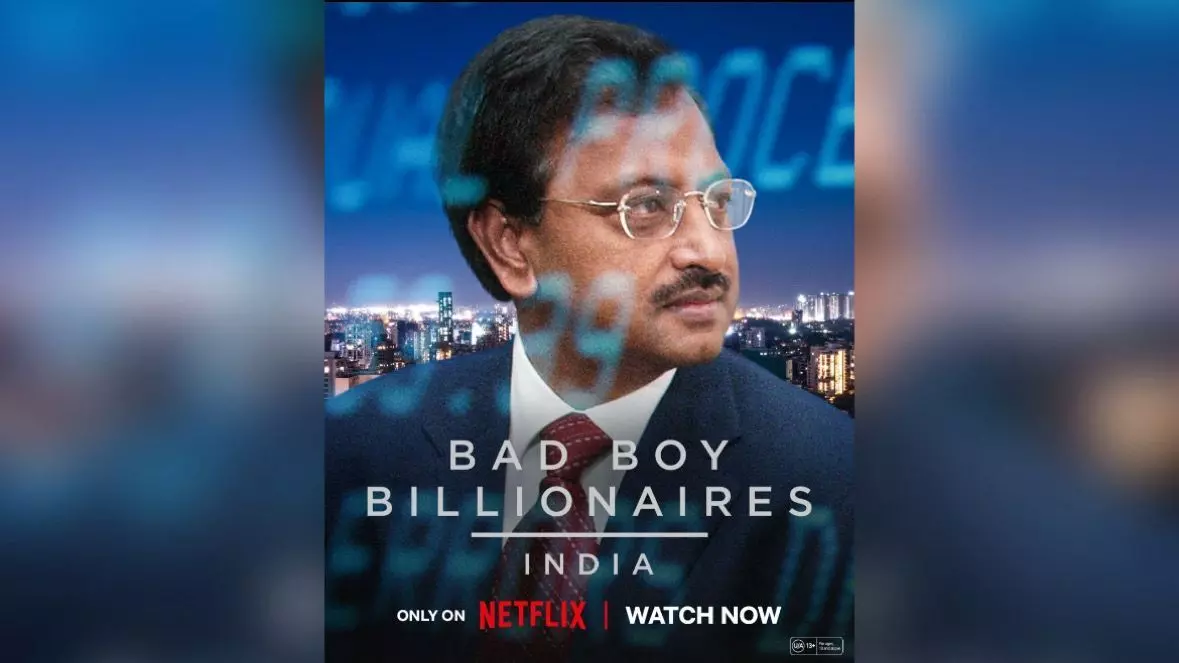
Netflix’s ‘Riding of Tiger’ captures the rise & fall of Ramalinga Raju in B=’Bad Boy Billionaires’
Hyderabad: On March 24, 2000; then President of the United States of America Bill Clinton, then Chief Minister of undivided Andhra Pradesh N Chandrababu Naidu and then Chairman of ‘erstwhile IT bellwether of India’ B Ramalinga Raju were all photographed together at a gala function at Cyber Towers on the occasion of the official visit of the POTUS.
The entire world noticed. And, a quarter of a century passed since then.
On August 13, 2025; The same Ramalinga Raju, who once was mobbed and jostled by hordes of people to be photographed alongside him, walks up to the dais to bless the couple at the wedding of the son of senior advocate Soma Bharat Kumar, general secretary of the Bharat Rashtra Samithi (BRS) and head of legal cell, who secured a bail for Raju and got him out of prison. And, nobody cares.
Those who recognised him, too, ignored.
Life in Hyderabad has come a long way.
Byrraju Ramalinga Raju, who, once, was regarded as a legend in the IT industry in India and a poster boy of India’s software services, is now an anathema.
In just a week from now, it will be 17 years since Raju, the legend of the past, gave up. He announced on the auspicious “Vaikuntha Ekadasi” day to the world that he had committed India’s biggest corporate fraud of the times.
Ashley Gething, a master storyteller, has captured the most significant part of the life of Ramalinga Raju – the rise and fall – and has perfectly woven a story around what happened and what would, otherwise, have happened, if the Dame Luck had indeed continued to smile on the typical of a dreamer that Raju has been in his 50-odd-minute episode entitled, Riding the Tiger, as part of the famous ‘Bad Boy Billionaires’ of India on the OTT platform, Netflix.
The episode on Raju had crossed all the legal hurdles and, as providence would have it, has finally seen the light of the day exactly on the Vaikunta Ekadasi day on December 30, 2025 on the OTT platform. It soon became a runaway hit with multitudes of viewers logging in to curiously watch the story that almost faded out of people’s memories.
While every episode of the ‘Bad Boy Billionaires’ was directed by one director of eminence each, Ashley Gething did the chapter on Ramalinga Raju roping in the alumni of Satyam Computers, a company that was finally acquired by Tech Mahindra, to narrate their points of view.
Being amid the thick of things as a reporter for India’s national newspaper, The Hindu, writing every bit of the Satyam Computers Scam and breaking several stories to the world, from the frontline, I can relate myself to every word that is spoken by the interviewees in the episode.
I proudly can claim how I belled the cat by smelling rat in the goings on in the company which was tended and raised with “Indian values and systems”, as presented by Sriram Karri, a senior journalist and a former Satyamite, in the episode.
Satyam had given pink slips to 400 associates, some of them were in higher bands and a large number of them were ELTPs (entry-level trainee programmers); and some were pushed on to the bench as part of the PIP (performance improvement program). The story was published on the front page of The Hindu. The same was followed up by many popular publications.
Some resorted to kite-flying by inflating the number of those shown the door and Raju had clarified in the press conference in October, 2008 when he released the Q2 results of the company, endorsing what I had written was accurate.
As a famous journalist and whistleblower in the infamous Harshad Mehta Stock Market Scam, Sucheta Dalal, had put it so appropriately in the ‘Bad Boy Billionaires’ episode, Satyam Computer was also – like many of its peers – under pressure to showcase better results quarter on quarter.
Raju had presented a rosy picture every time, including in the Q2 of FY09. Srinivas Vadlamani, the Chief Financial Officer and a finance wizard, was in cahoots with Raju, sharing every platform with him in public and partaking in drilling and widening the hole in the books of the corporate behemoth.
Every time, the Satyam Computer Services Ltd had announced the quarterly results, it used to present a bouquet of acquisitions. Little did anyone realise that this was part of a massive defalcation of funds.
It's noteworthy to mention that Satyam Computer Services Ltd used to publish its quarterly and annual results in a beautifully printed document christened as “Investor Link”.
Satyam Computer was the first company from Hyderabad to brag that it had entered the marquee billion-dollar club. But when the bubble burst, the corporate fraud was estimated to be a billion and a half US dollars (some wrote it was Rs 7,000 crore and some doubled it to be Rs 14,000-odd crore). Billion dollars those days was equal to Rs. 4,500 crore.
Raju was amassing huge land bank for his second son, Rama Raju’s Maytas Properties Pvt Ltd. His elder son, Teja Raju’s company, Maytas Infra Ltd, was a listed entity and doing extremely well on the bourses.
Raju’s mastermind worked in a reverse direction. He had his sons float these two companies and christened them as ‘Maytas” – a mirror image of the name of Satyam – read Satyam in reverse direction, as explained by Sucheta Dalal in the episode.
As Sriram Karri observed, Raju was the first to figure the way out to offer offshore services to American companies. He had later expanded to other geographies. He was the pioneer of outsourcing business in India and that pathbreaking model showed the route to many in the IT industry to heavily bank on offering outsourced software services.
Sriram went on to say Raju in Telugu meant a King. And, Ramalinga Raju wanted to be the King in the sphere of his realm – software and IT services; real estate and infrastructure. He indeed thought out of the box very early. Had he been able to tide over the crisis, he would have been regarded as Steve Jobs of India.
Sriram also clearly explained the context of Vaikunta Ekadasi to enlighten the curious minds on its significance. His observation that Raju had always been bothered about No.3 and No.5 – the digits -- was interesting. While the number 3 fascinated Raju, for Satyam was the fourth largest IT company after TCS, Infosys and Wipro in India at that time, he wanted to topple one of the troika to ensure Satyam scaled up to occupying the coveted third – if not the first or the second – slot. He was always worried about not slipping to the fifth position.
Why Raju became the darling of masses was the way he dressed himself up and conducted his persona among the honchos was well articulated by Arvind Krishna, a coaching coordinator of the former Satyam Computer.
Ed Cohen, the former Chief Learning Officer and vice-president of talent acquisition practice, was almost in tears when he had narrated how all his dreams and aspirations went kaput as a major player in the company, in the episode, after the scam unfolded.
The former Chief People Officer and Marketing head, Hari Thallapalli, who had seen Raju from the closest of quarters than anyone else, said when the scam erupted, all his 20 years of career got erased and how the future had looked bleak to him.
The Netflix episode explained how – in his bid to secure the contract for the prestigious Hyderabad Metro Rail project – Raju had tried to merge the companies of his sons into Satyam Computers and why he had to scrap the plan, after analysts took him to task.
I had also participated in the analysts’ call that evening when the merger was announced and listened to the barrage of critics ripping Raju apart and demanding his resignation.
Ramalinga Raju and his brother Rama Raju, then CEO of the company, exited the board meeting and let independent director Mendu Ramamohana Rao, then Dean of the coveted Indian School of Business, to chair the meeting, expressly to avoid the “conflict of interest” as it was an “interested party transaction.”
Other independent directors – TR Prasad (former Cabinet Secretary of India), VS Raju, Mangalam Srinivasan, Vinod Dham, Krishna G Palepu, and the likes – too were parties to the decision. However, TR Prasad had later said they were all taken on a “garden path” by Raju while pitching the idea of the merger.
I had the privilege of getting inside information very quickly, enabling me to break the stories of senior executives in the top echelons – like Ram Mynampati, Veerender Agarwal, Sriram Papani, Ravi Bommakanti, Subu D Subrahmanyan, and so on -- leaving the company, desolate and shattered.
So much so, I could chronicle the large clients of the Satyam Computer – like State Farm Insurance, Coca Cola, Quantas Airlines, World Bank, so on -- pulling the plug, forcing the company to lay off most of its associates.
The Government constituted a temporary board of directors with then NASSCOM chairman Kiran Karnik as its head and Chairman of HDFC Bank Deepak Parekh and former Securities Appellate Tribunal chairman C Achuthan as members. The Board led by Raju was disbanded. A S Murthy was appointed the interim CEO.
Satyam Computers, a beacon light of software industry in India with its novel ideas, had collapsed as Ramalinga Raju made the mega disclosure.
"It was like riding a tiger, not knowing how to get off without being eaten" is what B. Ramalinga Raju said in his 2009 confession letter to the Securities Exchange Board of India (SEBI) that led to the investor confidence in the company and also its net worth eroding faster than expected. An initial small lie of overstated profits and understated losses spiralled into an unmanageable monster.
The man, who, once, rode on the crest of his popularity, had suddenly seen his reputation nosediving and credibility taking a terrible hit. The empire he had built came crumbling like a pack of cards -- all of his own making and also unmaking. It suddenly became an untouchable for investors, lenders, and clients alike at a time.
Stung by the stigma of crashing a software giant for lying through his teeth and following it up with a volley of lies, Raju was incarcerated.
But I still feel if the sub-prime crisis did not hit the US markets in 2008 and Lehman Brothers did not collapse, the real estate market in India would not have bled and Raju could have covered up the hole in the Satyam books by appropriating the landbank he had built for Maytas Properties.
He would still have been leading the Hyderabad Metro Rail consortium as the principal concessionaire along with Navbharat Group and Italthai of Thailand.
Alas, if wishes were horses…


