$6-billion Rainbow Trout facility opens in Ranga Reddy, brings cold-water fish farming to Deccan plateau
The facility includes an on-site processing plant that produces value-added products like fillets and steaks. These are sold directly to consumers through a proprietary online store, ensuring traceability and freshness by bypassing traditional intermediaries.
By - Newsmeter Network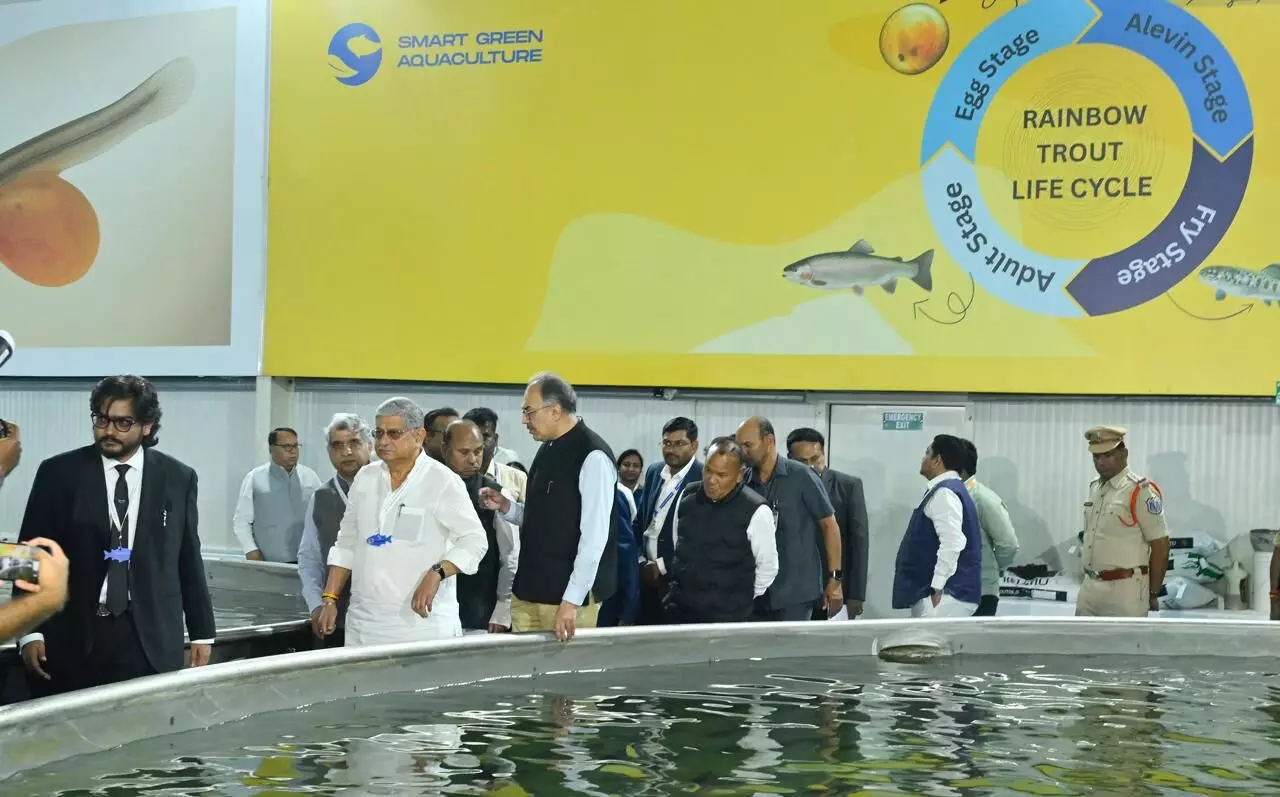
Hyderabad: India’s largest integrated inland Rainbow Trout farm in Kandukur mandal, Ranga Reddy district, was inaugurated by SmartGreen Aquaculture on Monday. The $6 billion facility has cold-water species which will thrive in the warm climate of the Deccan Plateau using advanced engineering.
The state-of-the-art facility was inaugurated by a high-profile delegation led by Rajiv Ranjan Singh (Lalan Singh), Union Minister of Fisheries, Animal Husbandry and Dairying. Joining him were Union Minister G Kishan Reddy and several other State and Central dignitaries.
Overcoming cold water barrier via RAS technology
Historically, trout farming in India has been restricted to the high-altitude, cold-water regions of the Himalayas. Smart Green Aquaculture is disrupting this model by using the Recirculating Aquaculture System (RAS) technology.
This closed-loop system treats and recycles water continuously, maintaining the precise temperatures and biosecurity levels required for trout, regardless of the external Hyderabad heat.
“Trout farming has traditionally been limited by geography,” said Aditya Rithvik Narra, the 31-year-old founder and Managing Director of SGA. “Our precision-engineered farm demonstrates that advanced closed-loop water systems can bring premium species closer to Indian consumers anywhere in the country.”
Massive scale for sustainability
The facility is designed for high-density, sustainable production with impressive technical specifications:
- Production Capacity: 1,200 metric tonnes (MT) annually.
- Infrastructure: 44 circular tanks (5 to 10 meters in diameter) operating at a stocking density of 70 kg per cubic meter.
- Hatchery: A 2-acre unit capable of producing 1.2 million fingerlings per year.
- Employment: The project has already created 200 direct and indirect jobs in the region.
The startup is also looking toward a ‘Circular Economy’ model.
The campus includes a Microalgae Biorefinery, set to be fully operational by 2026-27, which will produce biomass for aquafeed, nutraceuticals and pharmaceuticals.
Farm-to-Fork Integration
Beyond farming, SGA operates a fully integrated model.
The facility includes an on-site processing plant that produces value-added products like fillets and steaks. These are sold directly to consumers through a proprietary online store, ensuring traceability and freshness by bypassing traditional intermediaries.
“SmartGreen Aquaculture is a shining example of the innovation driving our nation’s startup ecosystem,” remarked Union Minister Rajiv Ranjan Singh during the ceremony. “To see them harness technology to farm cold-water fish in this climate is a remarkable achievement.”
Looking ahead
The global aquaculture market is projected to reach $421 billion by 2030, and India, currently the world’s second-largest fish producer, is positioning itself as a leader in this space through initiatives like the PM Matsya Sampada Yojana.
SGA plans to scale its current production from an initial phase of 360 MT to its full 1,200 MT capacity shortly. Additionally, the company has initiated technology transfer programs to help small-scale local farmers set up compact aquaculture units under buy-back arrangements, further integrating the local community into India’s Blue Revolution.


