Tech-enabled classrooms: How lessons are no longer confined to blackboards, textbooks
How technology and digital tools have transformed education
By - Anoushka Caroline Williams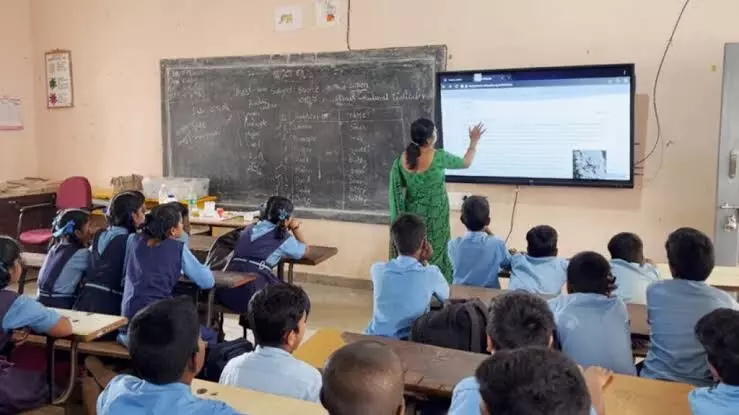
Technology and digital tools have transformed education in India
Hyderabad: Technology has quietly altered the everyday rhythm of classrooms. Lessons are no longer confined to blackboards and textbooks, and learning no longer ends when the school bell rings.
Digital tools have expanded how students engage with ideas, how teachers track progress, and how creativity and skills are developed within formal education systems. The change is not about devices alone; it is about how learning itself is being redesigned.
From information delivery to learning experiences
Earlier models of education focused on delivering information from teacher to student. Technology has shifted this dynamic. Classrooms now increasingly function as interactive learning environments where students explore concepts rather than passively receive them.
Digital platforms allow teachers to combine text, video, simulations, and discussion into a single lesson. A science concept can be tested through virtual labs. A history lesson can include archival footage and interactive timelines. This layered approach helps students connect theory with application.
“Technology works best when it supports curiosity. When students can test ideas instantly, learning becomes exploratory rather than instructional,” Lalit Aditya, an education researcher working on curriculum reform, told NewsMeter.
Creativity as a core learning outcome
One of the most visible changes technology has brought to classrooms is the renewed emphasis on creativity. Students are no longer evaluated only on correct answers but on how they think, design, and express ideas.
Creative production in daily learning
Classroom projects increasingly involve making rather than memorising. Students create presentations, short films, podcasts, digital posters, or simple software programs. These tasks demand original thinking and decision-making.
Satya Nara, a primary school teacher, describes this shift: “When students design a presentation or record a podcast, they are forced to organise their thoughts. Technology gives them a format, but the thinking has to come from them.”
Creativity in this context is structured. Students work within guidelines, deadlines, and learning goals, mirroring real-world creative work.
Skills being taught alongside academic content
Technology-enabled classrooms focus on skills that extend beyond subject knowledge. These skills are increasingly viewed as essential for higher education and employment.
1. Digital literacy
Students learn how to navigate information responsibly, identifying credible sources, understanding online ethics, and using digital tools effectively. This literacy is treated as a foundational skill rather than an optional one.
2. Critical thinking
Many digital tasks are open-ended. Students compare sources, interpret data, and justify conclusions. Technology supports this by providing access to multiple perspectives rather than a single textbook narrative.
3. Collaboration
Shared documents, group research platforms, and classroom management tools encourage teamwork. Students learn how to divide roles, resolve disagreements, and present collective outcomes.
A secondary school coordinator notes, “Group work has become more transparent. Teachers can see who contributes, who struggles, and how teams function.”
4. Problem-Solving
Coding exercises, design challenges, and simulations require students to identify problems, test solutions, and revise their approach. Mistakes become part of the learning process rather than something to avoid.
5. Self-Directed learning
Learning platforms allow students to progress at different speeds. This fosters independence and time management, especially in senior classes.
Teachers as facilitators, not replacements
Technology has not removed the teacher from the classroom. Instead, it has changed the teacher’s role. Teachers now guide discussions, mentor students, and design learning pathways rather than deliver information alone.
However, this transition requires training and support. Teachers must understand not just how tools work, but why and when to use them.
Nara reflects, “Technology does not reduce our responsibility. It increases it. We have to be intentional about how we use it.”
Parents and the question of balance
Parents often acknowledge the advantages of technology but remain concerned about screen time and overdependence. Many support digital learning when it is clearly linked to outcomes and not used as a substitute for teaching.
A parent of a middle-school student shares, “I can see my child learning new skills, but I want schools to be clear about purpose. Technology should add depth, not distraction.”
This has led schools to introduce screen-use guidelines, offline activities, and structured digital schedules.
Challenges that shape implementation
Despite its potential, classroom technology raises several challenges:
• Access gaps, where not all students have equal devices or connectivity
• Teacher readiness, especially in schools without consistent training
• Attention management, as digital tools can compete for focus
• Over-automation, where learning risks becoming mechanical if not guided
Addressing these issues requires policy planning, infrastructure investment, and continuous evaluation.
The direction education is taking
The future classroom is not fully digital or entirely traditional. It is a hybrid. Technology supports learning, but human interaction remains central. Teachers interpret student needs, encourage reflection, and create safe spaces for questioning and growth.
An academic advisor involved in education policy sums it up: “Technology gives us reach and flexibility. Teachers give learning meaning.”
Conclusion
Technology is reshaping education by expanding how knowledge is explored, how creativity is expressed, and how essential skills are developed. When used thoughtfully, it strengthens classrooms rather than disrupts them. The focus is no longer on tools alone, but on how those tools help students think, create, collaborate, and learn with purpose.


