Fact Check: Claim that keeping mobile phones in pockets causes male infertility lacks conclusive evidence
Studies suggest possible associations between mobile phone radiation and sperm quality, current scientific evidence does not conclusively prove that keeping phones in pockets causes male infertility.
By - Newsmeter Network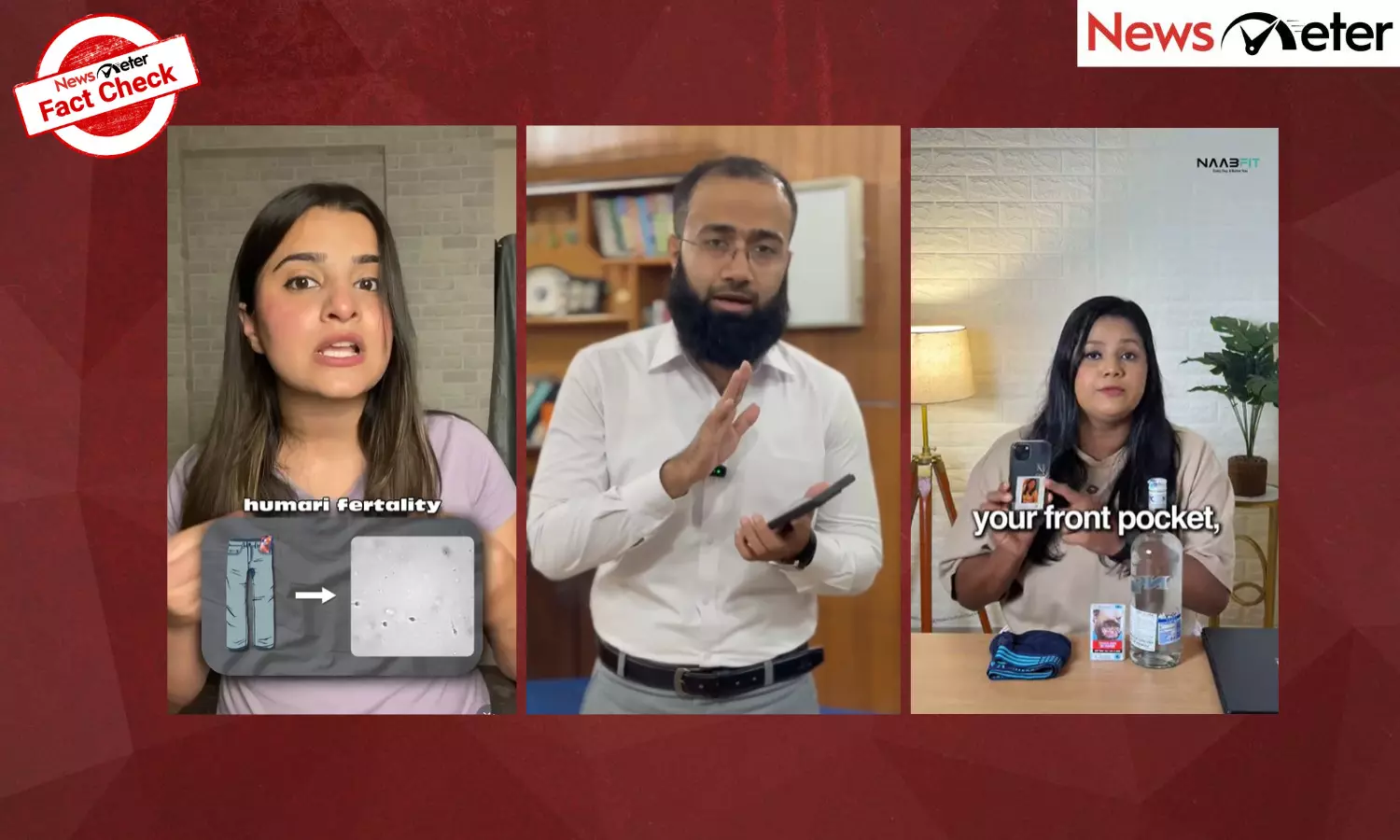
Hundreds of videos on Instagram warn men that keeping mobile phones in their pockets causes infertility, with some claiming definitive harm from electromagnetic radiation.
Instagram user, fitphysicofficial, warned: "Do not put your mobile phone in your pocket as it can put your health in silent mode. Electromagnetic radiation from mobile phones can be harmful. Keeping mobile phones in your pants pockets can also affect your fertility. Do not charge your mobile phone and use it. It increases heat and radiation by 10 times."
Dr Sulman Feroz, a chiropractor, claimed: "Mobile phones should never be kept in the front pocket. The reason for this is that the electromagnetic force coming out of it is very harmful for your sperm. It is strictly forbidden for men to keep it in the front pocket. Therefore, whenever you want to use a mobile phone, try to carry it in your hand or in the back pocket."
A Malayalam video by nabfit stated: "Dear men, if you always keep your mobile phone in your front pocket, the radiation and heat from your mobile will affect your sperm count and quality."
Fact Check
NewsMeter found that while some studies suggest possible associations between mobile phone radiation and sperm quality, current scientific evidence does not conclusively prove that keeping phones in pockets causes male infertility. Experts emphasize that observed effects show correlation rather than causation, and real-world risk remains uncertain.
What Actually Causes Male Infertility
A comprehensive study led by the Indian Council of Medical Research (ICMR) and the National Institute for Research in Reproductive and Child Health (NIRRCH) reveals that male factors contribute to approximately 20% of all infertility cases in India. The leading clinical cause was oligospermia (low sperm concentration), accounting for 36% of cases among men undergoing IVF treatment.
Other significant conditions include asthenospermia (reduced sperm motility) at 22%, azoospermia (total absence of sperm) at 51% in the broader infertility treatment group, varicocele (enlargement of veins in the scrotum) at 7%, and teratozoospermia (abnormal sperm shape) at 2%.
The ICMR study tracked background characteristics of participants. Among men seeking general infertility treatment, 33% reported alcohol consumption and 16% reported tobacco use. Additionally, 13% of men in the IVF group had a history of diabetes. The study found that 50% of husbands reported experiencing slight to moderate anxiety and depression due to infertility issues.
Importantly, the report treats alcohol and tobacco use as demographic data (who the patients are) rather than etiological data (what caused their condition). Mobile phone use was not identified as a leading cause of male infertility in this comprehensive national study.
What about studies
A 2014 study titled "The influence of direct mobile phone radiation on sperm quality" published in the Central European Journal of Urology. The study examined semen samples from 32 healthy men under controlled laboratory conditions, exposing them directly to mobile phone radiation for five hours.
The study has several key limitations. It was conducted in vitro, exposing semen samples directly to a mobile phone under laboratory conditions that do not reflect real-life use, where distance, body tissues, and movement reduce exposure. The sample size was small at 32 men. The experiment assessed short-term exposure and did not examine long-term effects. Exposure conditions were artificial and intense, with phones kept very close to samples.
Importantly, the study did not account for major confounding factors known to affect sperm quality, including alcohol consumption, tobacco use, and broader lifestyle habits. The findings suggest a possible association but do not establish real-world risk or causation. The study itself states: "A correlation exists between mobile phone radiation exposure, DNA fragmentation level and decreased sperm motility."
Another study cited a systematic review of animal studies examining mobile phone radiation effects on testes and sperm parameters. After screening more than 750 papers, the authors analysed 18 animal studies involving rats, mice, and rabbits. The review has important limitations: it is based entirely on animal studies, so findings cannot be directly extrapolated to humans. Exposure conditions were often artificial or extreme, not reflecting typical human mobile phone use. Crucially, the animal studies did not account for real-world confounders such as alcohol consumption, tobacco use, diet, physical activity, or stress.
Expert Medical Opinions
Dr James M. Hotaling, an expert in male fertility and andrology at University of Utah Health, stated: "I've never seen conclusive data that would lead me to advise a patient against carrying a cellphone in his pocket." He noted several possible flaws in previous studies, including selection bias from recruiting participants at fertility clinics and the natural variation in sperm count, which can change from hour to hour, day to day, and month to month.
Dr Hotaling emphasized: "Rather than focus on the insignificant variable of cellphone use, it's more important to look at other, more easily modifiable factors when it comes to determining male fertility. Diet and exercise are two such examples. However, there is one factor that matters most—age. People are waiting until later in life to conceive, so infertility is on the rise."
Dr Pramod Krishnappa, Andrologist at NU Hospitals Bengaluru, offered practical context: "Radiation is everywhere. Even a microwave oven in the kitchen emits radiation. Wi-Fi emits radiation. You are sitting under Wi-Fi all the time. Most people keep phones in their trouser pockets. As andrologists, we advise against that because it may affect fertility. But if you put it in a shirt pocket, a cardiologist may say it could affect the heart. So where do you keep the phone? The truth is, exposure is everywhere."
He concluded: "Does it affect fertility? Possibly, yes. Is there an easy solution? No. We are living with technology, and these are some of its side effects. Stronger and more conclusive evidence is still needed."
What Large-Scale Reviews Show
A WHO-commissioned systematic review analysed human observational studies examining mobile phone and RF-EMF exposure in relation to semen parameters. The review found no consistent or robust association between RF-EMF exposure and sperm concentration, motility, morphology, or total sperm count. The certainty of evidence was rated low to very low, mainly due to exposure misclassification, confounding, and heterogeneity between studies.
A 2024 systematic review and meta-analysis of 117 animal studies and 10 in vitro studies on human sperm found that most studies used RF-EMF exposure levels far above everyday human exposure, and no clear dose-response relationship relevant to public exposure limits could be established. A 2025 corrigendum to this review showed that when a single study using extremely high exposure levels was excluded, the association weakened and crossed statistical null values.
The viral claims that keeping mobile phones in pockets causes male infertility are not conclusively supported by current scientific evidence. While some laboratory and animal studies suggest possible associations and correlation between electromagnetic radiation and sperm quality, these studies have significant limitations including artificial exposure conditions, small sample sizes, and failure to account for major lifestyle factors like alcohol and tobacco use.
Large-scale human reviews find no consistent or robust causal link. Medical experts emphasize that observed effects show correlation rather than causation, and that infertility typically results from multiple factors including age, lifestyle, diet, and underlying medical conditions—not mobile phone use alone. The claim oversimplifies complex science and is misleading.


