Fact Check: India’s drone tech not as good as Pakistan’s, says NCC DG Virendra Vats? No, the video is AI-manipulated
By - K Sherly Sharon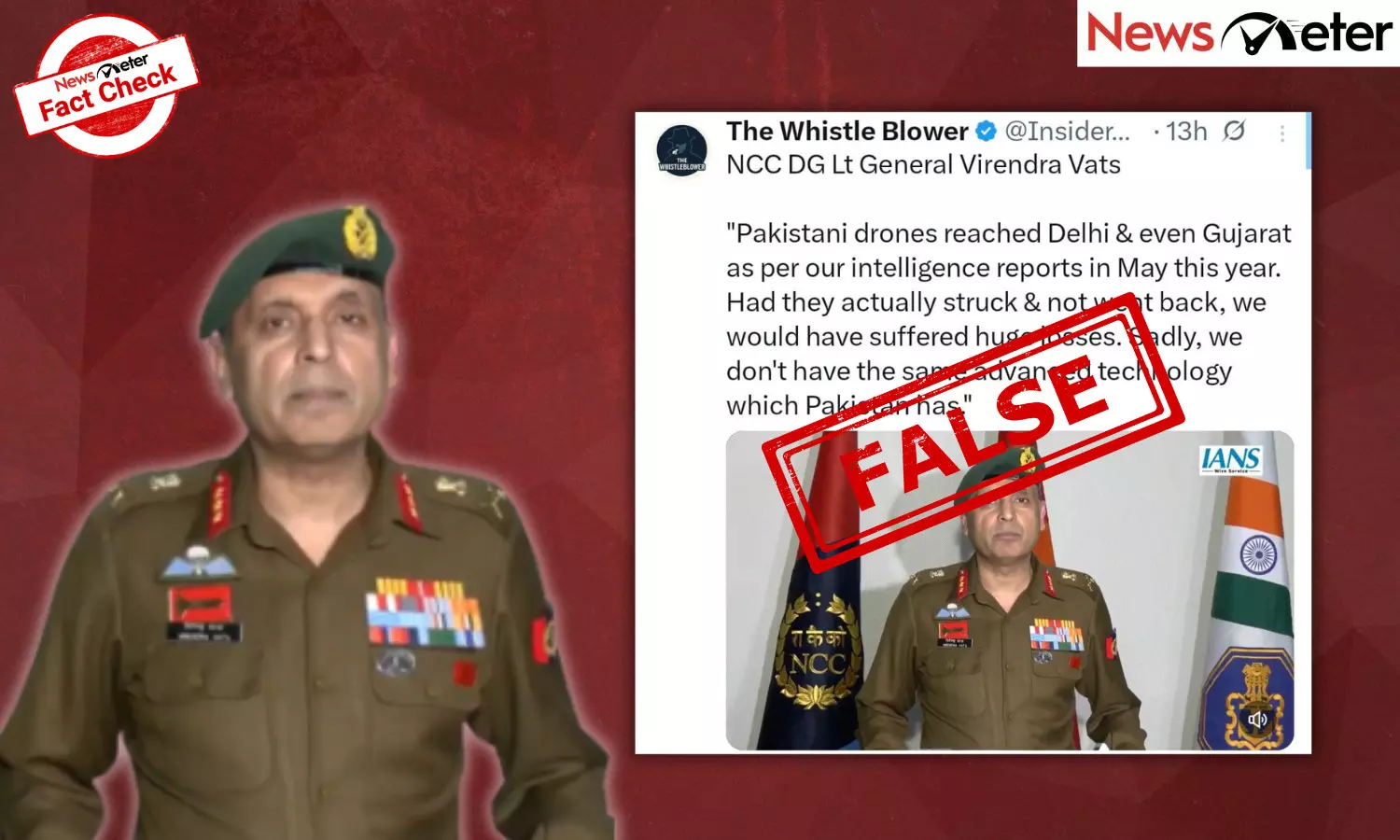
Claim:The video shows NCC DG Lt. Gen. Virendra Vats saying Pakistani drones reached Delhi and Gujarat in May, and India lacks technology compared to Pakistan.
Fact:The viral claim is false. The video was manipulated using Artificial Intelligence (AI).
Hyderabad: A video viral on social media claims to show the National Cadet Corps Director General, Lieutenant General Virendra Vats, making controversial remarks about border conflict.
He allegedly said that Pakistani drones reached Delhi and Gujarat in May, India lacks technology compared to Pakistan and that India will take ‘50 years’ to catch up.
In the video, Lt. Gen. Vats could be allegedly heard saying, “Pakistani drones reached Delhi and even Gujarat as per our intelligence reports in May this year. Had they actually struck and not gone back, we would have suffered huge losses. Sadly, we don’t have the same advanced technology which Pakistan has. It is partly due to their collaborations with Turkey and China. In my opinion, it will take more than 50 years for India, just to remain at par with Pakistan in terms of drone technology. Countering China is out of the question. India will never be able to do it.”
The video was shared on X (post withheld in India but accessible through a VPN) with Lt. Gen. Vats’ alleged statement as a caption. (Archive)
Fact Check
NewsMeter found that the claim is false. The video was modified using Artificial Intelligence (AI).
Source of the video
The viral video contains the logo of IANS on the top right. We checked the X profile of IANS and found a video of Lt Gen Vats addressing the media in a post shared on December 11. Both the viral video and this X video look like they are from the same meeting.
In this video, Lt Gen said that drones will play a major role in the economy, opening new opportunities for cadets while strengthening the nation’s defence in drone and cyber domains.
The caption read, “Mumbai, Maharashtra: NCC DG Lt. General Virendra Vats says, "Drones will play a major part in our economy. So, besides opening greater opportunities for our cadets, also ability to reinforce our defence forces in terms of drone and cyber issues. So, in the coming time, you will see that NCCC, you can say NCCCC, National Cyber Cadet Corps, some selected cadets will be given a first-class cyber training...”
The video did contain the controversial remarks from the viral video. We did not find any reports stating that Lt Gen Vats made the comments during this event or any other.
This hinted that the original video might have been tampered with.
Analysis of the video
Upon closely checking the viral video, we found that the lip movement is slightly lagged from the audio. We analysed the video frame by frame and found that at times, the viral video contained the exact same head and eye movements as the video in the IANS X post. However, the lip movement and the audio are different.
A side-by-side comparison of both the viral video and the IANS X post video can be seen here.
You can see how the head tilting and eye movements are the same. However, the lip movement and the audio are different. This indicated that the viral video was made using AI technology, mimicking the IANS video.
Using the AI detection tool, Hiya Audio Intelligence console, we found that the audio in the viral video is generated or modified using AI. There is only a 33 per cent match with live human markers.
Therefore, it is clear that the viral video is an AI-manipulated version of a real video clip showing Lt. Gen. Virendra Vats. He did not make the controversial comments as seen in the viral video. NewsMeter concludes that the viral claim is false.


