Fact Check: Massive fire in Tel Aviv after Iranian attack? No, clip is from Philippines
A video circulating online claims to show buildings burning in Israel after Iranian attacks.
By - Rahul Adhikari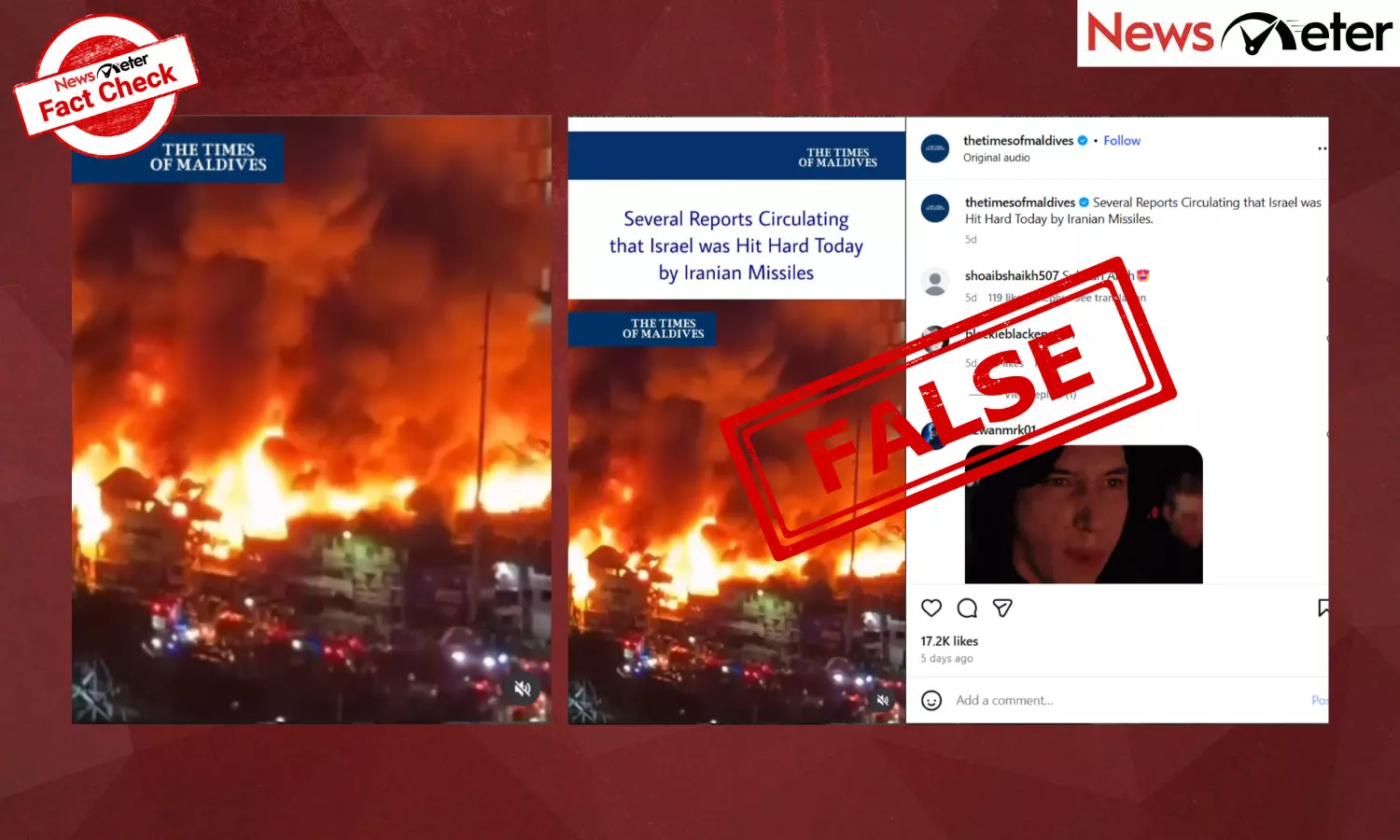
Claim:The video shows buildings burning in Israel after Iranian attacks.
Fact:False. The video shows a fire in a residential area in the Philippines in March, unrelated to the Iran–Israel war.
Hyderabad: A video circulating on social media claims to show a cluster of buildings burning in Tel Aviv, Israel, after Iranian airstrikes.
The viral clip shows a long stretch of buildings burning in massive flames, with thick plumes of smoke rising into the sky as the fire appears to spread across the area.
A report published by Reuters on March 7 suggests a sharp escalation in the Iran-Israel conflict, with both sides targeting key energy infrastructure across the region. The video was shared online in this context, allegedly showing an Iranian attack on Israel.
Several users shared the footage online, with a user on Instagram saying, “Several Reports Circulating that Israel was Hit Hard Today by Iranian Missiles.” (Archive)
Fact Check
NewsMeter found that the claim is false. A video showing a fire in a residential building in the Philippines was falsely shared as an Iranian attack on Israel.
Analysis of the viral video
We took screenshots of the video and conducted a reverse image search using Google Lens. The results led us to a similar video published on March 7 by a Philippines-based media outlet, GMA News.
We reviewed both videos carefully and found that they show the same incident. We identified a few matching elements, including a tower on the left and a building on the right, which are present in both videos
The caption of the YouTube video, written in Filipino, states that it shows a fire that broke out on a section of NIA Road in Barangay Pinyahan, Quezon City, on March 6.
We found a news report published by GMA News Online on March 7 stating that more than 4,000 families lost their homes and one person died after a fire burned a residential area in Quezon City on March 6. The fire quickly spread along NIA Road, engulfing houses mostly made of light materials.
The news article included a video report of the incident showing a massive fire burning through the residential area. We spotted the same tower and residential building in the video as well.
It is evident that the video in question is not from Israel. Therefore, we conclude that the claim is false.


