Fact Check: STs to lose reservation after religious conversion? No, here’s what Supreme Court said
A post circulating on social media claims that members of the ST community will lose their reservation following religious conversion
By - Rahul Adhikari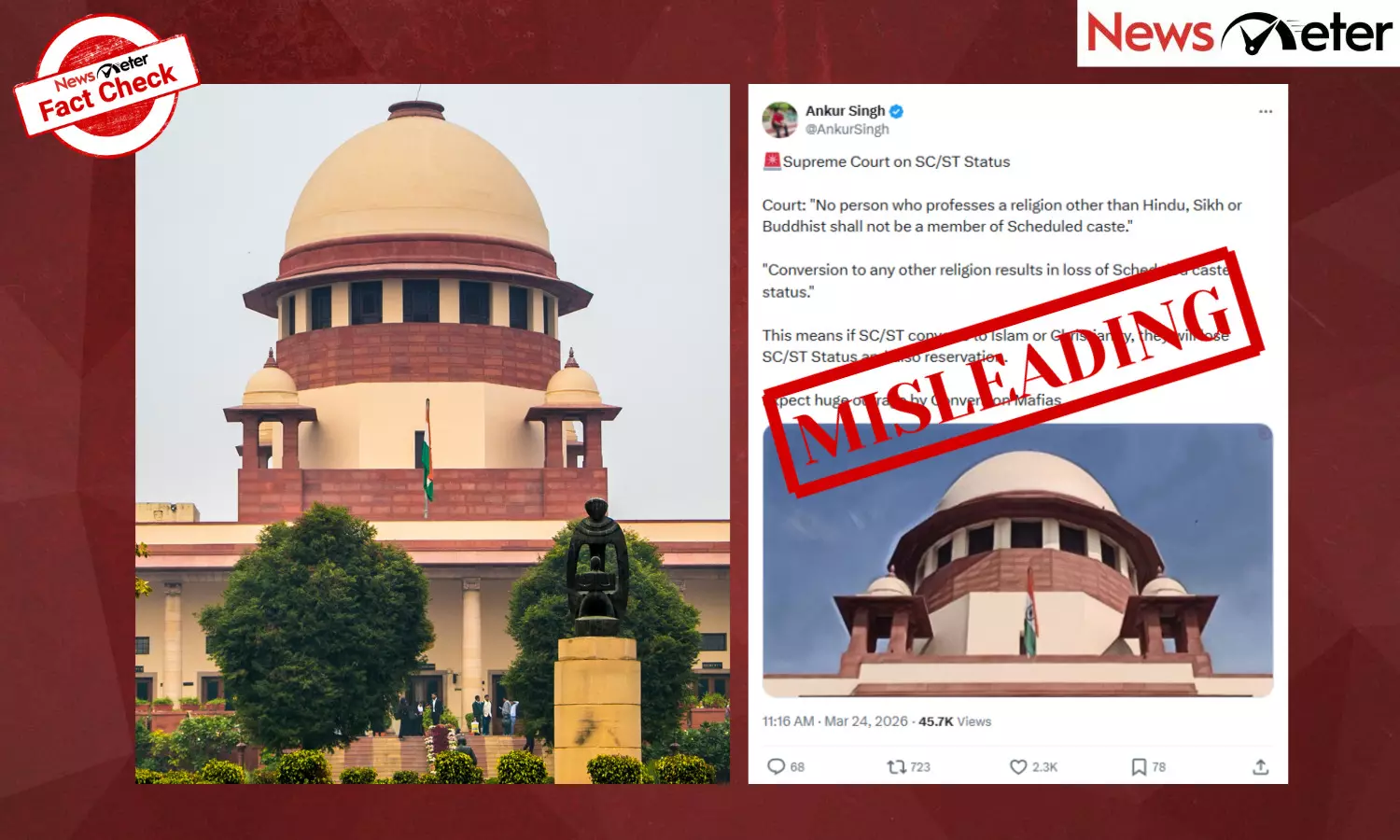
Claim:Members of the ST community will lose their reservation if they convert to Islam or Christianity.
Fact:Misleading. Only members of the Scheduled Caste (SC) community will lose their reservation status if they convert to any other religion beyond Hinduism, Sikhism and Buddhism.
Hyderabad: A post circulating on social media claims that persons belonging to the Scheduled Tribe (ST) categories will lose their reservation if they convert to Islam or Christianity.
The post surfaced after the Supreme Court upheld a decision related to the SC/ST (Prevention of Atrocities) Act on March 24.
Several users made similar claims on X and Facebook. An X user wrote, “Supreme Court on SC/ST Status Court: ‘No person who professes a religion other than Hindu, Sikh or Buddhist shall not be a member of Scheduled caste.’ ‘Conversion to any other religion results in loss of Scheduled caste status.’ This means if SC/ST converts to Islam or Christianity, they will lose SC/ST Status and also reservation. Expect huge outrage by Conversion Mafias. (sic)” (Archive)
However, what did the Supreme Court actually say?
Fact Check
NewsMeter found that the claim is misleading. Only the Scheduled Castes (SC) community will lose their reservation status if they convert to any religion other than the Hindu, Sikh and Buddhist faiths. The judgment does not affect the ST community.
What was the Supreme Court judgment?
The Supreme Court, on March 24, stated that a person who converts to Christianity cannot claim Scheduled Caste (SC) benefits.
A bench of Justices Prashant Kumar Mishra and Manmohan upheld the Andhra Pradesh High Court’s order, stating that a person cannot profess a religion other than Hinduism, Sikhism or Buddhism and simultaneously claim SC status, as the two are mutually exclusive under the Constitution.
The order sits at the intersection of two ideas.
One is the constitutional framework of the Scheduled Caste status, defined by the Constitution (Scheduled Castes) Order, 1950. The other is caste-based discrimination, which studies show can persist even after conversion, especially among Dalit Christians.
What does the law state?
The court based its decision on constitutional and legal provisions that link the Scheduled Caste status to religion. This framework stems from the Constitution (Scheduled Castes) Order, 1950, issued under Article 341.
Paragraph 3 of the order states, ‘No person who professes a religion different from Hinduism shall be deemed to be a member of a Scheduled Caste’.
Therefore, this order removes SC status from those who convert to a religion other than those specified in it. The judgment was made only for the members of the SC community.
Does the judgment affect ST status?
No, the judgment does not affect members of the ST community. This means that even if they convert to another religion, including Islam or Christianity, they do not lose their reservation status.
According to Article 342 of the Constitution and the Constitution (Scheduled Tribes) Order, 1950, ST communities are identified based on tribal identity and region.
Paragraph 1 of the Article 342 reads, “The President may, with respect to any State or Union Territory, and, where it is a State, after consultation with the Governor, by public notification, specify the tribes or tribal communities, or parts of or groups within them, which shall be deemed to be Scheduled Tribes for the purposes of this Constitution.”
Unlike the Scheduled Castes order, there is no provision restricting ST status to specific religions.
What do legal experts say?
For further clarification on the judgment, NewsMeter reached out to Supreme Court advocate Abhilash MR, who said that the ruling applies only to the Scheduled Caste community.
He explained that the Supreme Court order is confined to members of the SC community, as the Constitution (Scheduled Castes) Order, 1950, imposes religious restrictions. In contrast, the Constitution (Scheduled Tribes) Order, 1950 has no such restriction.
He added that if a person belonging to the Scheduled Tribes continues to retain their tribal identity, they remain entitled to legal protections, including reservation, even after converting to another religion.
Based on the evidence, it is clear that the top court’s ruling applies only to the Scheduled Caste community, and the Indian Constitution does not impose any religious restriction on the Scheduled Tribe status.


