Fake govt scheme ads promising rewards target social media users in 2025
Advertisements on Meta platforms misuse the names of government schemes, leaders’ images and UPI systems to lure users into reward-based scams in 2025.
By - K Sherly Sharon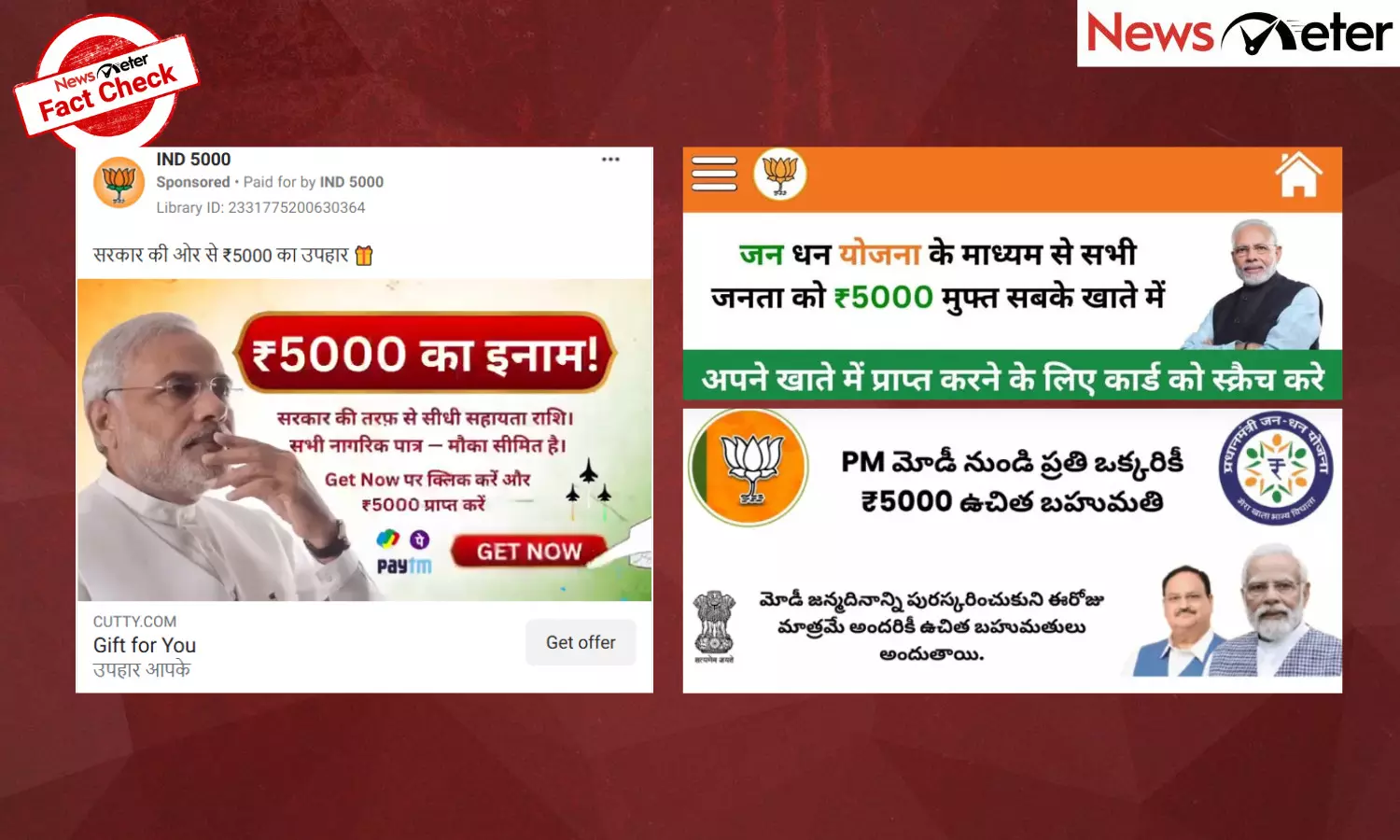
Hyderabad: In 2025, social media saw an influx of fake advertisements claiming to reward users with easy money. However, from their design to operation style, they are built to scam people of their personal data while leading them to shady websites.
NewsMeter has exposed several such viral advertisements in 2025. Here are some examples to illustrate the method behind the scams:
Using Meta Ads to spread fake rewards
A ‘Meta Creative’ is the advertisement content used on social media platforms such as Facebook and Instagram. It consists of images, videos and text.
Typically, the creative is a small video with a voiceover that is generated using Artificial Intelligence (AI), designed to attract attention and hold interest. These creatives are often seen carrying texts and audio in various regional languages to reach as many people as possible in a particular area.
The call to action for most ads is a link for the user to interact. However, scammers are using Meta Ads to lure people into stealing money from unsuspecting social media users.
The design of the advertisement endorsing fake rewards
These would invite users with a promise to send money directly into their bank accounts.
It would show a believable reward (Rs 2,000 to Rs 9,000 award) in exchange for a small action. The ad will display text that says ‘Click to get reward’ or ‘Get offer’. Since the instructions are easy to follow, most people will click on the links and land on shady websites.
How does it work?
Using an advertisement on Meta that is now viral, let us understand how this scam works.
This advertisement started running on December 29, 2025. It shows an image of PM Modi, UPI app logos and the Hindi text that, when translated, reads, “₹5000 reward! Direct financial assistance from the government. All citizens are eligible - limited time offer. Click on Get Now and receive ₹5000”.
The audio mimics the Prime Minister’s voice saying, “Brothers and sisters, click on the Get Offer button now and receive a reward of up to Rs 5,000 from me”. We analysed this audio file using Hiya Deepfake Voice Detector and found that the audio is a deepfake, with an authenticity score of 6 out of 100.
This advertisement was paid for by user ‘IND 5000’. The caption under this ad video reads, “Gift of ₹5000 from the government”. The link on this ad opens a website with the domain that starts with ‘yojan.shop’. (Archived version of the website)
The website contains two images of the Prime Minister, the BJP logo and the text, “Through the Jan Dhan Yojana, all citizens will receive ₹5000 free in their accounts. Scratch the card to receive the amount in your account.”
The website shows a scratch card and the text under it reads, “A gift of up to ₹5000 for every Indian citizen from the Prime Minister’s Jan Dhan Yojana. Click here to transfer to your bank account.”
Clicking as prompted redirects the user to the PhonePe app with a transfer money request.
How fake ads sell themselves as real
To make the ad look credible and build trust at a glance, they would often carry signage of common financial apps. ‘PhonePe’ logo has been used on the creative, making the user believe that the reward would arrive in the form of a UPI transaction.
These creatives sometimes feature images of Prime Minister Narendra Modi, the Indian Emblem or the logo of the Bharatiya Janata Party (BJP). Home Minister Amit Shah and Chief Minister of Uttar Pradesh, Yogi Adityanath, have also been featured on the creative.
Along with images of PMs and CMs, the ads attract attention using the words ‘Yojana/Scheme’.
One of the viral advertisements reads, “Prime Minister’s Employment Project… Under the employment project, 5000 rupees will be deposited into each citizen’s account”, and another claims “Click the lotus flower button and get 5000 rupees in your account. 5000 reward is being given to every Indian citizen’s account”.
Another type of Meta Ads Creative would show a woman or a man smiling while holding up money. It would create urgency in the user by claiming a ‘limited time offer’.
Speaking to NewsMeter, Aduri Inna Reddy, Founder Chairman of Cyber Helps NGO, said that these scam advertisements are designed to draw the attention of the users.
“Facebook is still very popular among rural populations, older users, economically vulnerable groups and people with limited digital literacy. They are attracted to the short reels and they do not realise when such short video ads appear and get mixed up with entertainment. Common people are attracted to government logos, photos of popular leaders and schemes,” he said.
He further added, “Some users see the word ‘scheme’ and think that they might receive the amount with just a click. They believe there is little harm in trying, especially when the promised reward is small enough to seem believable.”
The government schemes that exist, rewards that don’t
These viral ads often claim to provide access to various government schemes that would help users earn money when they click on the links in the ad. Even though the schemes use the names of real government schemes, the rewards they promise are never true.
1. Prime Ministers’ Rozgar Yojana
The text on an ad reads, “Pradhan Mantri Rozgar Yojana…Click the button and receive ₹5000 in your bank account”. However, how real is this offer?
Prime Ministers’ Rozgar Yojana (PMRY) was announced on August 15, 1993, and it was discontinued in 2007-08. The main objective of the PMRY scheme was to provide easy subsidised financial assistance to educated unemployed youth for starting their own enterprises in the manufacturing, business, service and trade sectors.
There are no announcements about the return of the scheme. There are no announcements or press releases regarding the distribution of money up to Rs 5,000 directly in people’s bank accounts through any employment scheme.
2. Pradhan Mantri Mudra Yojana (PMMY)
Another viral ad contains the logo of the Pradhan Mantri Mudra Yojana (PMMY) with the text, “Click on the Get Offer button and win ₹5000.” But this offer is not real.
Pradhan Mantri Mudra Yojana (PMMY) is a Government of India scheme that provides collateral-free loans to micro and small enterprises to help them start or expand their businesses.
The official website did not contain any information on this offer. There are no news reports or credible social media sites talking about this offer. The scheme offers loans and not rewards for clicks.
3. Pradhan Mantri Jan Dhan Yojana
An advertisement shared a link that directed us to a shady website. This website consisted of the Pradhan Mantri Jan Dhan Yojana logo, giving the website the appearance of an authentic scheme-related website. (Archived version of the website)
Pradhan Mantri Jan Dhan Yojana is a Government of India scheme that aims to provide universal access to basic banking services like a zero-balance bank account, debit card and insurance to every household.
However, the official website of this scheme does not show any notifications or press releases regarding a ‘free gift’. There is no news coverage regarding the same.
Under this scheme, there are no provisions where citizens could receive monetary benefits into their bank accounts by ‘clicking on a button’.
Along with promises of monetary rewards and help from the government through these schemes, these ad creators cite occasions such as Prime Minister Narendra Modi’s birthday and Independence Day to attract users. The text on one such shady website reads, “To commemorate Modi's birthday, free gifts will be given to everyone today only.” (Archived version of the website)
The shady websites
Clicking on the link posted on one of the viral Facebook posts led us to a website where the domain name starts with ‘winzo.could’, which was unusual for an official site. Additionally, Google Chrome and Mozilla Firefox browsers flagged the webpage as a ‘Dangerous Site’. (Archived version of the webpage)
This webpage contains two images of PM Modi, the BJP logo and a scratch card. The text on the top reads, “Rs 5,000 free to all citizens through the Jan Dhan Yojana. Scratch your card to receive it in your account.”
The scratch card revealed an amount of 993. The text below states, “Up to 5,000 gifted to every Indian citizen through the Pradhan Mantri Jan Dhan Yojana. Send to bank account by clicking here.”
Upon clicking as prompted, automatically opens the PhonePe app, with a pre-filled UPI payment request. A screen appeared showing a request to pay Rs 993 to an unknown UPI ID.
The Hindi text in the description box reads, “Select the account you want the Cashbank amount to be deposited in”.
On tapping the ‘Pay 993’ button, the app prompts for the UPI PIN. This shows that this action would authorise a payment from the bank account to the scammer’s account.
The website uses a deep link, a type of link that directs users to a specific location within an app, to open PhonePe with pre-filled details to trick users into approving the transaction.
Instead of sending money to the user, entering the UPI PIN would deduct the money from the victim's account to the scammer.
Another such link leads to a website with ‘ispot.cc’ in the domain. (Archived)
The website shows the images of PM Modi, Union Minister and BJP President Prakash Nadda, the Government emblem, the BJP symbol, along with the logo of ‘Pradhan Mantri Jan Dhan Yojana’.
It also shows logos of UPI apps like PhonePe, Paytm and BHIM. It also displays a message saying, ‘Your Balance ₹686’.
The text on the website reads. “Free gift of ₹5000 to everyone from PM Modi. On the occasion of Modi’s birthday, the free gifts can be availed only today. Click below to send money to your account. Send money to your account”.
This ends the same way as the previous Facebook advertisement did. A UPI app opens with pre-filled details, prompting for the UPI PIN so the scammer could get the ‘reward’ quietly.
Similarly, one more shady website from the advertisement on Facebook contained the text ‘Yojan4999.shop’ in the domain (Archive)
The blank website
After 2-3 days of the advertisement going live, the scam website link is replaced with a dummy. This new website does not contain any information related to the government scheme as claimed in the advertisement. It displays ‘Lorem ipsum’ text, which is widely recognised as placeholder content used to fill space during website development.
Ads shut down by Meta
On the Meta Ad Library page of the user ‘IND 5000’, most of the ads run by these scam advertisers were already taken down with the explanation, “This content was removed because it didn’t follow our Advertising Standards.” However, the run time of these ads suggests that the damage was already done.
Even though most of the ads were removed by Meta for violating advertising standards, the user kept running ads for similar scams. The campaigns also ran for very short periods, ranging from less than one hour to around 23 hours. This shows that the user was trying to avoid detection by Meta.
The scam advertiser
This page ‘IND 5000’ has over 4,400 followers. The profile picture of the account is the BJP logo. The Meta Ads Library shows that this user ran over 200 advertisements on Facebook and Instagram throughout December 2025. Although most of them were taken down by Meta, active ads still existed.
Many of these ads promoted a false claim of a ‘₹5000 government reward’ and redirected users to suspicious external websites.
The estimation of the total amount spent by the advertiser ranges between Rs 1,10,000 and Rs 1,40,000. The estimated total impressions on these advertisements range from 3.8 million to 4.8 million. That means that these ads were shown to millions of Facebook and Instagram users.
A similar advertisement pattern can be observed in the case of other users such as JDY Service 2026, Dhan Yojana, Claimsome 15 and NDA Center 2026.
Who are targeted?
Based on the ad delivery data of 10 such advertisements, the audience reached was overwhelmingly male, with men forming 70 to 80 per cent of viewers. Of these, the age groups 18 to 24 and 25 to 34 were targeted by the ad.
One of the comments on these video ads is by a user, Ramesh Kumar Ram, who wrote, “Sir, my money has been deducted. Please refund my money.”
In many cases, users do not realise immediately that they have been scammed. These advertisements are especially deceptive with repeat victims who have not yet realised how their money was deducted.
“Due to a lack of awareness, they may recognise the fraud only after several days. This happens when they notice an insufficient balance while attempting another payment. In some instances, it is only after someone else points it out that they realise money from their accounts has been deducted. Even then, the link between the scam advertisement and the deduction is not always made right away,” said Aduri Inna Reddy.
Because of this lack of awareness, many victims do not report the fraud to the authorities. Aduri Inna Reddy said that if such incidents are reported within the first hour, referred to as the ‘Golden Hour’, there can be an 80 to 90 per cent chance of recovery.
How to keep safe from UPI scams?
This is a reward-based scam executed using UPI, where instead of receiving money, it will be sent to the scammer’s account. The viral Facebook Ad is a clickbait which leads you to a scam website that tries to dupe users into sending them money through UPI.
If the browser flags the webpage as a ‘Dangerous Site’, it is best to keep out of it. However, depending on various factors, it may take several hours to days for the warning to kick in. In that case, before trusting any website, check the URL carefully, and avoid domains that look suspicious or unusual. Look for HTTPS security, spelling errors and fake logos.
It is not required to enter the UPI PIN to receive money. If a link opens the UPI app and shows a payment screen, it’s a payment scam. Close the app immediately.
In case you have been a victim of a UPI payment scam, inform your bank immediately. Report the fraud to the local police station and register a complaint with the National Cyber Crime Reporting portal, either on the phone (Dial 1930 for the helpline) or via their website.


