Adulteration crackdown: Why Hyderabad police ended up doing food dept's job
S. Sangeetha Satyanarayana, Commissioner of Telangana’s Health and Family Welfare, who oversees food safety in the state, describes the enforcement problem in terms that explain the shift
By - Newsmeter Network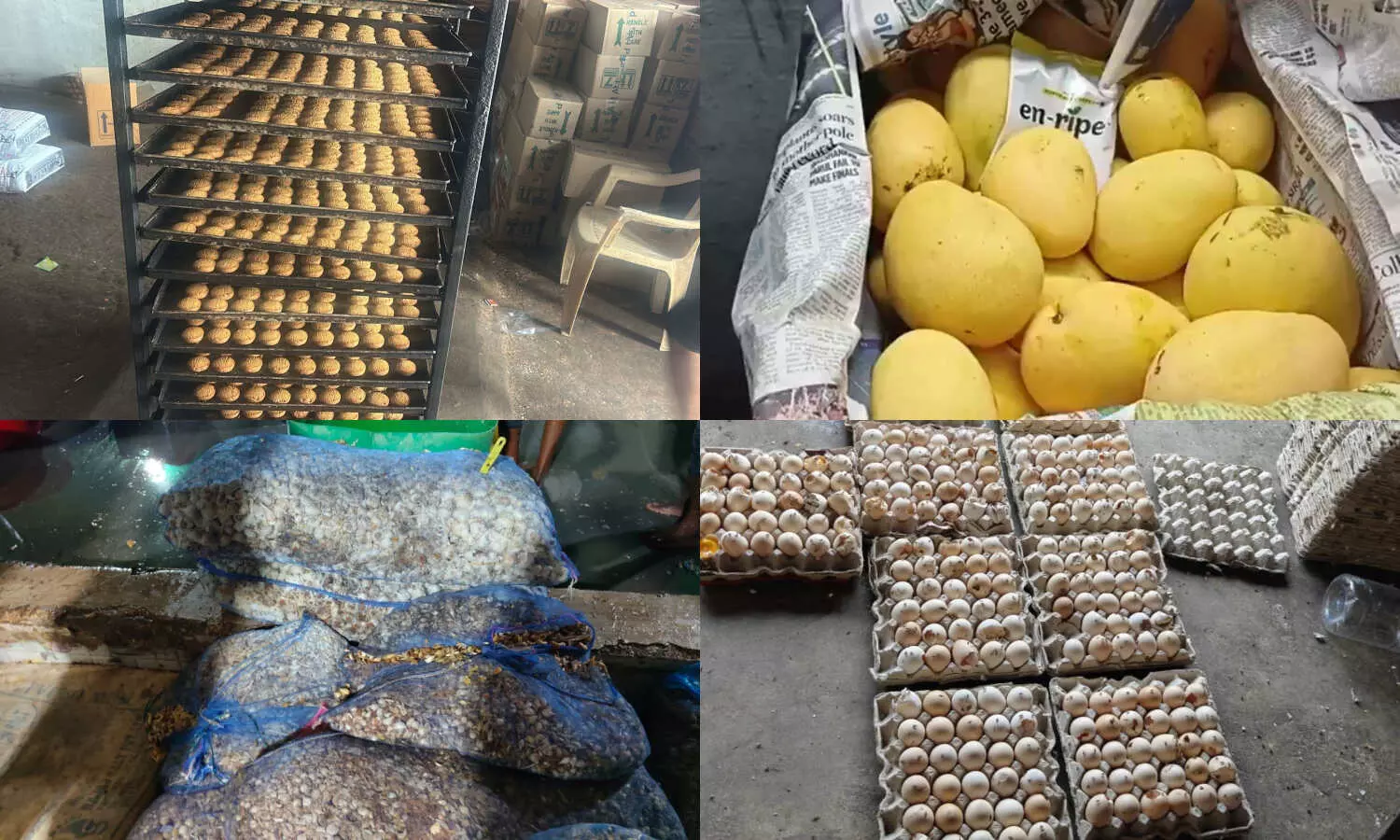
File Photo
Hyderabad: When the Commissioner's Task Force and Tappachabutra Police walked into Chand Bakery in Natraj Nagar last month, they found maida, dalda, loose chicken, and cake powder stored under conditions that no food licence had ever approved.
The owner, Syed Khadeer, had been supplying bakery products to kirana stores, cafes, and hotels across Hyderabad without a valid food licence, manufacturing licence, labour licence, or trade licence. He was arrested, and goods worth Rs 2,77,630 were seized.
The case was registered under Sections 274, 275, and 318(4) of the Bharatiya Nyaya Sanhita (BNS), not under the Food Safety and Standards Act.
That choice of law is not incidental. It sits at the heart of why Hyderabad Police, and not the state's food safety machinery, now leads enforcement against food adulteration in the city.
`A vicious cycle’
S. Sangeetha Satyanarayana, Commissioner of Telangana’s Health and Family Welfare, who oversees food safety in the state, describes the enforcement problem in terms that explain the shift.
"Repeat offenders are a major challenge. It is a vicious cycle. No matter how many inspections we conduct, the same violations tend to recur," she said.
The Food Safety and Standards Act, she explained, makes speed structurally difficult. Once a sample is collected, an initial report takes around 14 days. A mandatory 30-day appeal window then follows before prosecution can begin. Many offenders use that window to send samples to laboratories in other parts of the country, adding another 15 days or more to the timeline.
"By the time we proceed to court, nearly two months are already lost," she said.
The BNS cuts through that. Section 274 covers adulteration of food intended for sale. Section 275 covers the sale of food known to be noxious or unfit for consumption. Section 318(4), the most serious of the three, treats the act of deceiving consumers into accepting dangerous products as cheating and carries a punishment of up to seven years in prison. Police can arrest immediately at the point of seizure. No 14-day sample window. No 30-day appeal period.
That is the logic behind the Chand Bakery case, and behind the broader architecture that has taken shape in Hyderabad since March 2026.
H-FAST and the gap it fills
In March 2026, the Hyderabad City Police launched H-FAST, the Hyderabad Food Adulteration Surveillance Team, a 28-member unit operating under the Commissioner's Task Force and working alongside Food Safety Officers. The unit conducts surprise raids on manufacturing units, warehouses, and eateries, acting on ground-level intelligence that Satyanarayana acknowledges food safety officers often do not have on their own.
"Food Safety Officers alone may not know where illegal units are operating. When police are involved, enforcement becomes stronger," she said.
Within its first weeks, H-FAST registered 61 cases, arrested 64 people, and seized roughly 15 tonnes of adulterated products. Operations dismantled units producing fake paneer, adulterated spices, and contaminated biscuits.
Seven tonnes of adulterated mangoes were seized from a godown in Asif Nagar. Over 4,000 kilograms of ginger-garlic paste adulterated with acetic acid and xanthan gum came out of a unit in Kattedan. On 1 April, 12 tonnes of spoiled offal were recovered from a meat store in Mangalhat.
What the national data shows
The urgency behind that mobilisation becomes clearer when set against three years of enforcement data tabled in Parliament by Union Minister of State for Health Prataprao Jadhav, covering 2022-23 to 2024-25.
In three years, Telangana's food safety authorities tested 14,312 samples. They cancelled 16 licences. They filed zero criminal cases.
The retreat continued into 2024-25. Sampling fell 46 per cent in a single year. Civil cases dropped 71 per cent. Licence cancellations reached a new low of one.
Other states enforced the same law across the same period. Kerala secured 206 criminal convictions in 2024-25 alone. Karnataka recorded 34. Chandigarh, a Union Territory of barely one million people, recorded 41 convictions from just 374 samples. Andhra Pradesh, which shares Telangana's geography, food culture, and regulatory architecture, pursued criminal enforcement every year. Telangana did not pursue it once.
A partnership by necessity
Satyanarayana frames the current arrangement as coordination, not substitution. Cases are booked under the BNS for immediate action while the Food Safety Act process handles sampling and technical classification in parallel, avoiding double jeopardy.
Around 11,000 street vendors have gone through hygiene and food safety training. A public helpline, 8712661212, now channels complaints directly to the enforcement machinery.
"That is why coordination with the police becomes important. They have the manpower, and we have the legal mandate," she said.
The record, however, suggests the coordination arrived after years of near-absent enforcement by the agency that holds the legal mandate. Syed Khadeer had been running an unlicensed bakery, supplying food to hotels and stores across the city, before a police tip brought officers to his door. The food safety department, which exists precisely to find operations like his, had filed no criminal cases in the three years prior.
The police are now doing the job. The question the parliamentary data raises is why it took this long.


