From more tanks to crackdown on misuse, HMWSSB chief orders plan for uninterrupted water supply during Summer
The MD ordered strict action against the misuse of potable water for washing vehicles, cleaning premises and other non-essential purposes
By - Sistla Dakshina Murthy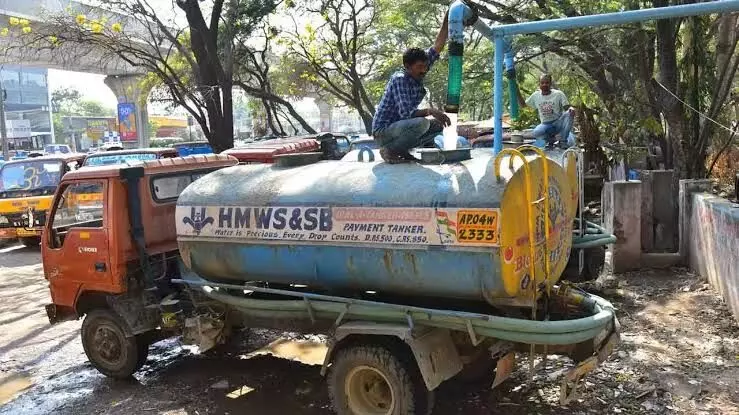
File Photo
Hyderabad: Ahead of the peak summer season, HMWSSB Managing Director Ashok Reddy has instructed officials to prepare detailed, area-wise action plans to ensure uninterrupted drinking water supply across the GHMC and Outer Ring Road (ORR) limits.
He also directed them to intensify revenue recovery and groundwater recharge efforts.
Summer Action Plan 2026
The directions were issued during a detailed review meeting at the Water Board headquarters in Khairatabad, here on Friday, attended by Executive Director Mayank Mittal and senior officials.
The meeting reviewed the Summer Action Plan 2026, drinking water distribution, tanker operations, revenue, rainwater harvesting, complaint redressal mechanisms and new connection approvals.
Micro-level strategy for summer supply
The MD emphasised that water supply planning must be done at the field level, with constant monitoring of allocation and distribution in every locality.
Officials were instructed to immediately rebalance supplies in areas facing shortages and strictly adhere to scheduled supply timings to avoid public inconvenience.
Tanker supply to be strengthened where needed
Anticipating higher demand during the summer, Ashok Reddy asked officials to prepare demand-based plans for tanker water supply.
He noted that the city currently operates 1,150 tankers, 90 tanker filling stations and 150 filling points. Proposals for setting up additional filling stations should be submitted in high-demand areas, he said.
General Managers were also directed to work in close coordination with transmission officials to monitor inflows and ensure equitable water distribution.
Crackdown on drinking water misuse
The MD ordered strict action against the misuse of potable water for washing vehicles, cleaning premises and other non-essential purposes.
He instructed the Chief Vigilance Officer to conduct special enforcement drives in localities where illegal motors are used during supply hours and to initiate stern action against offenders.
Revenue collection: Focus on arrears and high-value users
Revenue enhancement was identified as a key priority.
Ashok Reddy directed officials to identify commercial connections with outstanding dues and ensure their recovery on a priority basis. He said targeted action on arrears could significantly improve the Board’s monthly revenue.
Consumers with water usage bills of Rs 1,000 and above must be identified, with a clear mandate of 100 per cent billing and 100 per cent collection.
In addition to regular targets, each section manager was asked to recover dues from the top 50 defaulters every month. The MD warned of strict departmental action against officials showing negligence in revenue collection.
Flow meters to plug transmission losses
To reduce water loss, the MD announced that flow meters would be installed at every docket and matched with readings at the consumer end.
This system, he said, would help accurately identify transmission losses and enable corrective measures to prevent wastage of precious drinking water.
15,000 rainwater harvesting pits in 100 days
Stressing the importance of groundwater recharge, Ashok Reddy said rainwater harvesting pits would be made mandatory for houses up to 200 square yards and for all premises above 300 square yards within the next 100 days.
He called upon officials to work with full commitment to achieve the target of constructing 15,000 rainwater harvesting pits under the ‘One House–One Harvesting Pit’ initiative across GHMC and ORR areas.
Defunct borewells to be revived as injection wells
The MD revealed that out of 8,285 borewells within GHMC limits, 4,569 are currently defunct. He directed officials to convert these borewells into injection wells by linking them with rainwater harvesting pits.
In addition, rainwater harvesting pits will be constructed in around 1,200 government school premises across four neighbouring districts. Letters in this regard will be addressed to the respective District Education Officers.
Long-term plan to reduce dependence on new water projects
Ashok Reddy said that installing 50,000 rainwater harvesting pits in the ORR region over the next five years could recharge 5 to 10 TMC of water annually.
Such sustained groundwater recharge, he noted, could eliminate the need for future phases of the Krishna Drinking Water Supply Scheme and other new drinking water projects.
Faster approvals, priority to public complaints
The MD directed officials to promptly process and approve applications for new water connections, warning of departmental action against delays.
He also instructed that complaints received through the Metro Customer Care (MCC), particularly those related to contaminated water, sewer overflows and missing manholes, be resolved on priority. Offline complaints must also be brought under the MCC system for timely redressal.


