Iran pushing for peace with 10-point plan: Former Lieutenant Governor Najeeb Jung in Hyderabad
Iran’s resilience and peace push discussed by diplomats and scholars in Hyderabad seminar
By Kaniza Garari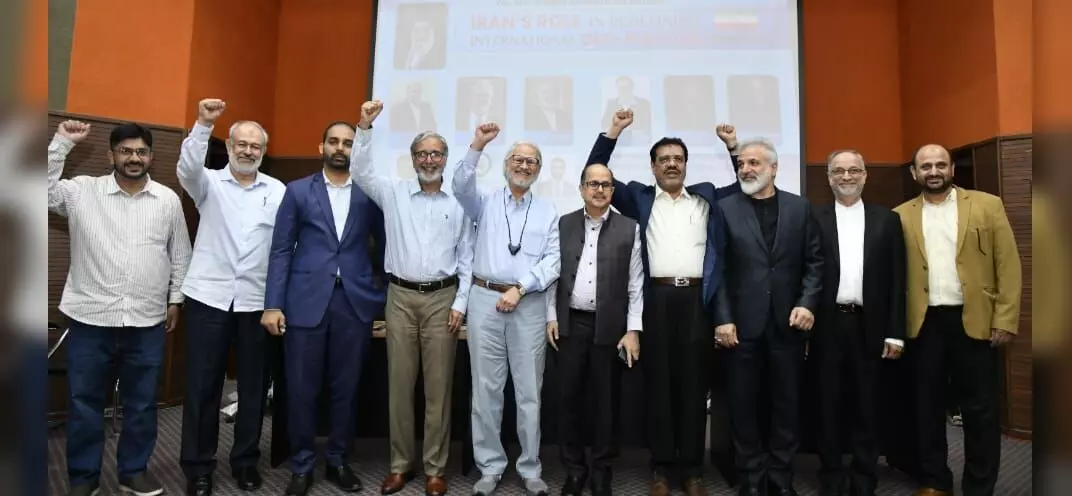
Hyderabad: Experts discuss Iran’s role in ‘reshaping geopolitics and pushing for peace’
Hyderabad: “Iran continues to push for peace, offering a 10-point proposal to improve global conditions,” said former Lieutenant Governor of Delhi, Najeeb Jung, at a national seminar organised in Hyderabad on “Iran’s Role in Redefining International Geopolitics.”
The seminar in Hyderabad had Indian diplomats and scholars who discussed ‘Iran’s resilience in the face of global pressure’.
The event, organised by Judicial Quest, had former Secretary in the Ministry of External Affairs, Dr Ausaf Sayeed, as its chief guest.
‘A new course for history’
Speakers at the seminar highlighted how Iran has effectively ‘changed the course of history by confronting major world powers while enduring severe hardships.’ They emphasised:
Resilience under Fire: Najeeb Jung compared the recent suffering in the region to the tragedy of Karbala, noting that despite the loss of life—including a claimed 80,000 children—the Iranian people demonstrated extraordinary patriotism.
Leadership Continuity: Dr Ausaf Sayeed said that despite targeted attacks on Iran’s top leadership, the nation has maintained stability through quick succession.
A New World Order: Dr Sayeed remarked that a new ‘might is right’ world order has emerged, yet Iran continues to push for peace, offering a 10-point proposal to improve global conditions.
Solidarity
Multiple speakers emphasised that despite external attempts to frame the regional tension as a Shia-Sunni conflict, such efforts have failed. There is no such internal issue within Iran.
Iran’s Consul General, Hamid Ahmadiya, expressed his gratitude to the Indian people for their solidarity, stating that Iran’s journey is a story of ‘resilience, identity, and hope’.
India’s strategic connection with Iran
The seminar also touched upon India’s role, with former BBC correspondent, Qurban Ali, expressing regret that India had not fully supported its ‘good friend’ during the current crisis.
This highlights the complex, millennia-old relationship between the two nations in aspects such as:
1. Historical and Cultural Ties: India and Iran share deep-rooted linguistic, cultural and artistic ties. Persian was the official language of the Indian courts for centuries, and the two nations share similar traditions in architecture, poetry and philosophy.
2. Strategic Energy Partnership: Iran has historically been one of India’s largest suppliers of crude oil. While international sanctions have complicated this trade, Iran remains a vital partner for India’s long-term energy security.
3. The Chabahar Port and Connectivity: The Chabahar Port in Southeastern Iran is a cornerstone of India’s regional strategy.
It allows India to bypass Pakistan to trade with Afghanistan and Central Asia. It is also a key node in the International North-South Transport Corridor (INSTC), a multi-modal route linking India to Russia and Europe.
4. Regional Stability: Both nations share a mutual interest in a stable Afghanistan and the containment of extremist groups in the region.
Despite the ‘sensitive times’ mentioned by the Consul General, India continues to balance its strategic partnership with Iran alongside its relationships with the United States and Israel.


