Only 0.95% rainwater percolates into ground despite average rainfall of 85–89 cm in Hyderabad: HMWSSB MD Ashok Reddy
The large-scale loss of rainwater has led to rapid depletion of groundwater
By - Newsmeter Network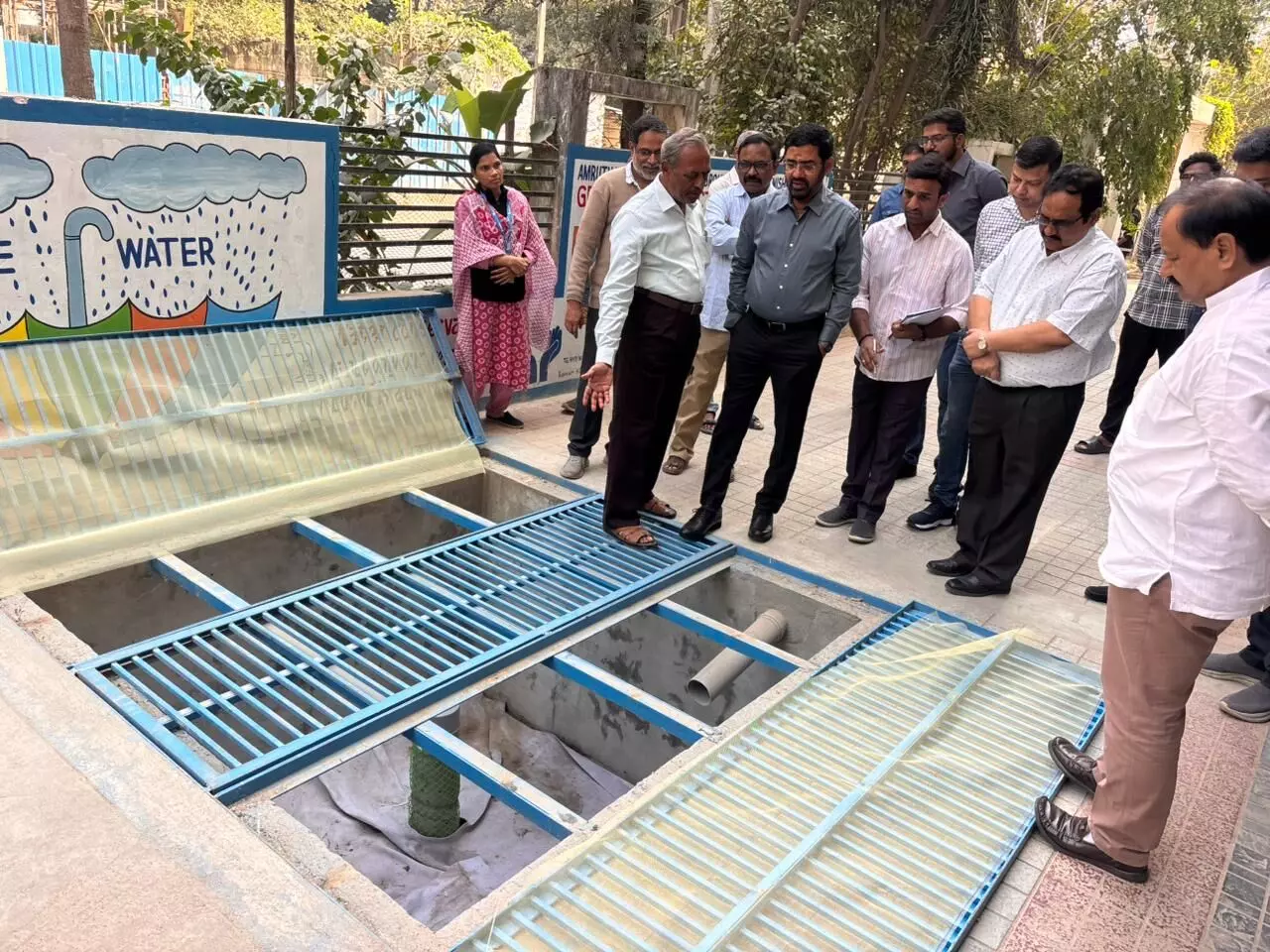
Hyderabad: Barely 0.75–0.95 per cent of the rainwater percolates into the ground despite the average annual rainfall of 85–89 cm in Hyderabad.
Hyderabad Metropolitan Water Supply and Sewerage Board (HMWSSB) managing director Ashok Reddy said the bulk of the rainwater flows into stormwater drains and eventually into the Musi River.
The large-scale loss of rainwater has led to rapid depletion of groundwater and a sharp rise in tanker demand across residential colonies, he added.
Recharge pits made mandatory
To arrest the decline in groundwater levels, Ashok Reddy announced that recharge pits have been made mandatory based on plot size.
While every residential plot up to 200 square yards must have a recharge pit, plots exceeding 300 square yards are required to construct one within their premises.
He said the initiative aims to conserve rainwater, restore groundwater levels, and ensure sustainable water availability for domestic use.
100-day action plan from next week
Ashok Reddy said the Water Board has prepared a 100-day special action plan, which will be launched from next week, to accelerate groundwater recharge across Hyderabad and within the Outer Ring Road (ORR) limits.
The plan focuses on mass adoption of rainwater harvesting structures through public participation under the “One House–One Recharge Pit” campaign.
Awareness drive begins at Madhapur
As part of the campaign, the HMWSSB MD, along with senior officials, visited Madhapur here. He interacted with residents and highlighted successful water conservation practices.
Ashok Reddy appreciated residents of an apartment complex in Kakatiya Hills, comprising 15 flats, for overcoming water scarcity by installing an injection borewell system, calling it a model for community-led water management.
CM’s directive to improve groundwater
The Water Board MD said the action plan was drawn up following directions from Chief Minister A. Revanth Reddy, with a focus on increasing groundwater levels within the ORR region.
He stressed that gated communities, residential welfare associations, and commercial establishments must actively participate in groundwater recharge efforts.
Concrete expansion blocks natural recharge
Ashok Reddy pointed out that extensive concretisation of residential, commercial, and open spaces has severely reduced natural rainwater infiltration.
“As a result, groundwater levels have fallen sharply, borewells have dried up and dependence on tankers has increased even for non-drinking water needs,” he said.
Survey reveals recharge infrastructure gaps
Based on tanker booking data, the Water Board surveyed 40,209 residential premises that booked more than 20 tankers per month. The survey revealed that 22,825 premises had recharge pits, while 17,384 did not.
So far, notices have been issued to about 16,000 households, directing them to install recharge pits. Another 25,000 houses are targeted to be covered by March 2026.
Four-pronged groundwater recharge strategy
To maximise rainwater harvesting, the Water Board will roll out a four-pronged groundwater recharge plan, which includes:
Mandatory recharge pits for large residential and commercial plots.
Conversion of defunct borewells into injection borewells.
Construction of public recharge pits in colonies, parks, government premises, and educational institutions.
Channelising rooftop rainwater into recharge structures through pipelines.
Special awareness programmes will also be organised for gated communities and high-rise apartments.
National recognition for water conservation efforts
In recognition of its initiatives, HMWSSB recently received the ‘Jal Sanchay Jan Bhagidari (JSJB) 1.0 Award’ under the Top Municipal Corporation category.
The award was presented to Ashok Reddy by President Droupadi Murmu in New Delhi and includes a Rs 2-crore cash incentive to strengthen water conservation programmes.
Recharge pits can reduce need for new water projects
Ashok Reddy said that widespread adoption of recharge pits could help channel 5–10 TMC of rainwater annually into the ground, potentially eliminating the need for future large-scale water supply projects.
“We spend crores pumping water from distant reservoirs while rainwater flows unused into drains. If harvested locally, it can revive borewells, reduce tanker dependence, and save public money,” he said.
Calling for collective action, he urged citizens to treat rainwater harvesting as a civic responsibility to secure the city’s water future.


