India's school dropout crisis
Over the last five years, more than 6.5 million (65 lakh) children in India have dropped out of school, Minister of State for Women and Child Development Savitri Thakur revealed in Parliament.
By - Mohammad Asif Iqbal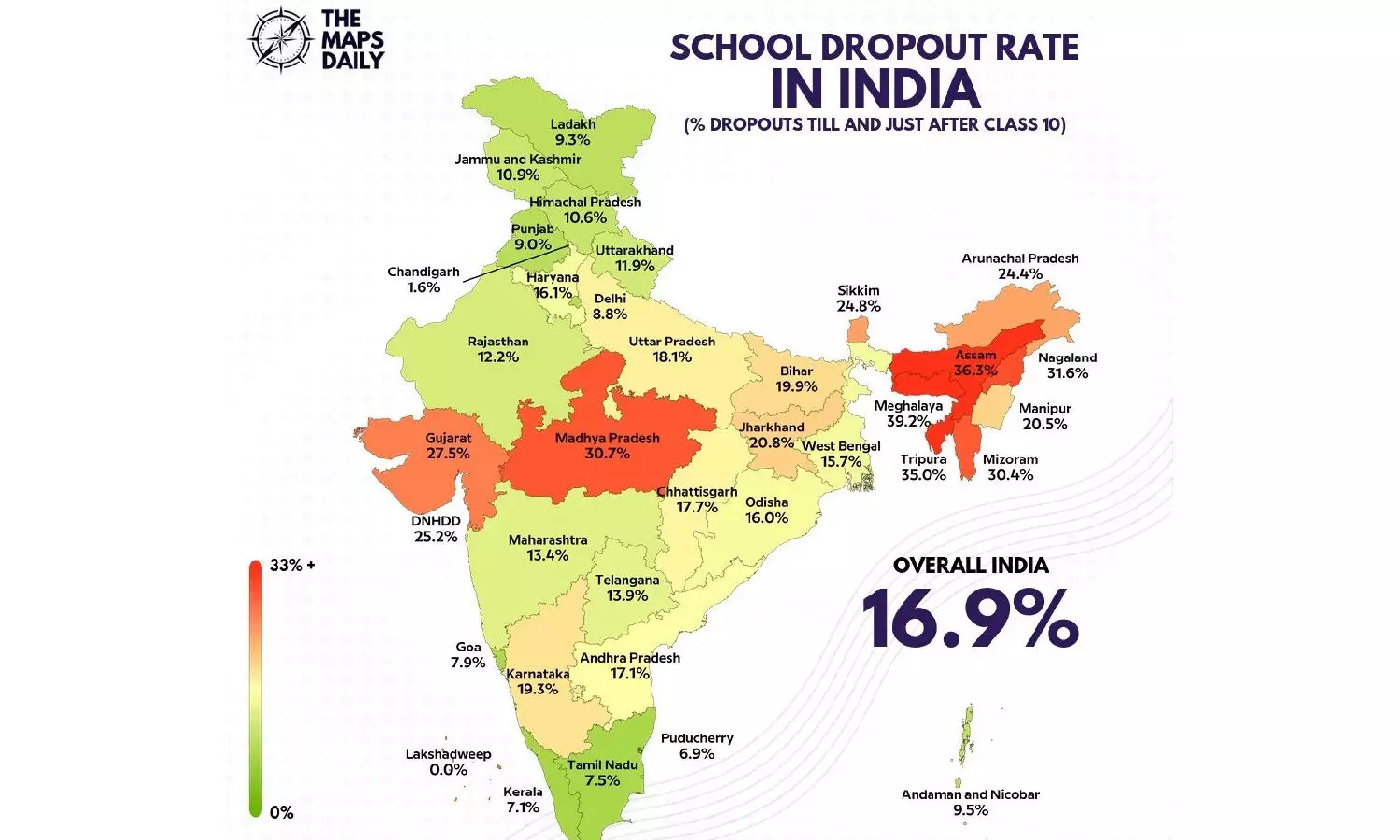
New Delhi: School admissions for the academic session 2026-27 have started from Nursery to KG and from Class 1 to 9, with different schools releasing their admissions from January 2026.
The new academic session and classes in most schools will begin in the first week of April 2026. But the most critical and unresolved issue of dropouts from the schools in India remains pending, particularly in rural and marginalized areas or the backward communities belonging to socio-economic conditions.
In India, the socio-economic backward communities or the groups have five categories: (i) Other Backward Classes (OBC), these communities are identified by the government as "socially and educationally backward".
They are entitled to a 27% reservation in public employment and higher education, (ii) Socially and Educationally Backward Classes (SEBC), often used interchangeably with OBC, this is the formal constitutional term (Articles 15 and 16) for groups requiring affirmative action due to social and educational handicaps, (iii) Economically Backward Classes (EBC), a newer category that identifies individuals strictly by economic deprivation (income and assets), regardless of their caste or social background, (iv) Scheduled Castes (SC) and (v) Scheduled Tribes (ST), while distinct from the "Other Backward Classes," these groups are also considered "socially disadvantaged" due to historical untouchability (SCs) or geographical and cultural isolation (STs).
The dropout issue is common in the mentioned communities and groups.
Over the last five years, more than 6.5 million (65 lakh) children in India have dropped out of school, Minister of State for Women and Child Development Savitri Thakur revealed in Parliament. Among them, nearly 3 million (30 lakh) are adolescent girls.
The numbers point to a large-scale rupture in India’s promise of universal education, and also to structural gaps in the way schooling is planned, supported, and delivered, especially for children from marginalised families.
The data shows that 65.7 million children left school between 2019 and 2024. Of these, 2.98 million were girls in the adolescent age group, as reported by India Today.
A state-wise breakdown revealed that Gujarat recorded the highest number of out-of-school children in the 2025–26 academic year. The state identified 240,000 (2.4 lakh) such children, including 110,000 (1.1 lakh) girls. In comparison, Gujarat had reported only 54,541 out-of-school children in 2024. This marks a jump of over 340 percent in a single year.
Other states with high dropout numbers included Assam, which reported 150,906 (1.5 lakh) out-of-school children, of whom 57,409 were girls. Uttar Pradesh recorded 99,218 dropouts, including 56,462 girls.
The Ministry cited a range of factors contributing to the dropout of girls from school. These included migration, poverty, household responsibilities, child labour, and social pressures.
For girls, the dropout journey is even more layered. They are expected to take care of younger siblings, fetch water, cook meals, and sometimes even earn income. In many families, especially in rural and tribal areas, there is pressure for early marriage or fear about girls’ safety if they travel to far-off schools. Each of these factors pushes them out of classrooms.
A recent state-level policy in UP may have worsened the problem. The government decided to merge schools with fewer than 50 students into nearby institutions. While this may sound efficient from an administrative point of view, for many children, particularly girls, it means having to walk longer distances, often alone. For families already hesitant to send girls to school, this can be the final push towards dropping out.
“The difficulties in the documentation process for admission, coupled with difficulties in getting pre-matric and post-matric scholarship by Other Backward Classes (OBC), Scheduled Caste (SC) and Scheduled Tribes (ST) students, prevent some students from these marginalised groups from accessing education,” Beena Pallical of National Campaign on Dalit Human Rights was quoted as saying.
Girl students’ enrolment dropped by around 1.6 million, while boy students fell by about 2.1 million between 2022-23 and 2023-24. SC category students declined by 1.2 million, and ST by 200,000. The number of students categorised as OBC dropped by over 2.5 million, and among all minority communities, there was a combined decrease of 300,000.
Government & NGO has initiated so many schemes to control the school dropouts, like (a) Samagra Shiksha Abhiyan: An integrated scheme from preschool to class 12 providing free uniforms, textbooks, and transport allowances. (b) Mid-Day Meal (MDM) Scheme: This remains one of the most effective incentives for keeping children from low-income families enrolled by providing daily nutritional support. (c) "Bringing Children Back to School": A targeted campaign to re-enroll dropouts by involving local panchayats and School Management Committees, etc., but the issue is not solved yet.
Whereas the National Education Policy aims for 100% Gross Enrolment Ratio (GER) from preschool to secondary level by 2030 in terms of 100% Gross Enrolment ratio, this status-oriented analysis identifies strengths and challenges. The UDISE+ 2024-25 report, disseminated in September 2025, captures data on schools, enrolments, teachers, and infrastructure across the country.
India has 1,471,473 schools, with an average of 168 students and 7 teachers per school. However, 7,993 schools have zero enrolments, and 104,125 (7.1%) are single-teacher schools serving 3,376,769 students, signaling resource inefficiencies. States like Telangana (2,245 zero-enrolment schools) and Uttar Pradesh (9,508 single-teacher schools) contribute significantly to these figures.
About 5.1% of schools have fewer than 10 enrolments, and 8.0% have 11-20, indicating underutilization, particularly in rural areas. Infrastructure includes 1,377,945 schools (93.6%) with electricity (1,352,061 functional, 91.9%), 1,372,205 (93.2%) with girls’ toilets (1,372,881 functional, 93.3%), though digital library access is limited to 101,505 schools (6.9%). States from the north-eastern parts of the country, like Assam, Arunachal Pradesh, Mizoram, Tripura, etc., show lower electricity coverage (below 90%).
In the current situation, based on the data cited above, Central and State Governments, as well as NGOs working to resolve the educational issue at different levels, should take the dropout issue on a priority basis; otherwise, the 100 percent enrolment target of the NEP 2020 cannot be achieved.
On the other hand, even if the target of 100% enrollment is achieved and the problem of children dropping out of school cannot be solved, then such 100% enrollment will not achieve anything. Because this enrollment does not help children transition from school to college, and at a time when children cannot enter college and higher education or professional education from school, it is inevitable to raise questions about such an education system.
The question also arises as to why the problem of child dropout is not taken seriously in the country. Do the government and its institutions themselves want the backward and socially weak classes, groups, and minorities to continue to suffer from the same conditions? If this is the case, which, although not written, certainly appears to be practical, then this situation is not only regrettable but also flawed and painful in terms of policy.
(The author is a freelance journalist from New Delhi. He has extensively written on rural India. He can be reached at maiqbaldelhi@gmail.com )


