Air quality critical for public health, economy and productivity, says Deputy CM Bhatti
Poor air quality impacts public health, productivity and economy said Telangana deputy chief minister Bhatti
By - Newsmeter Network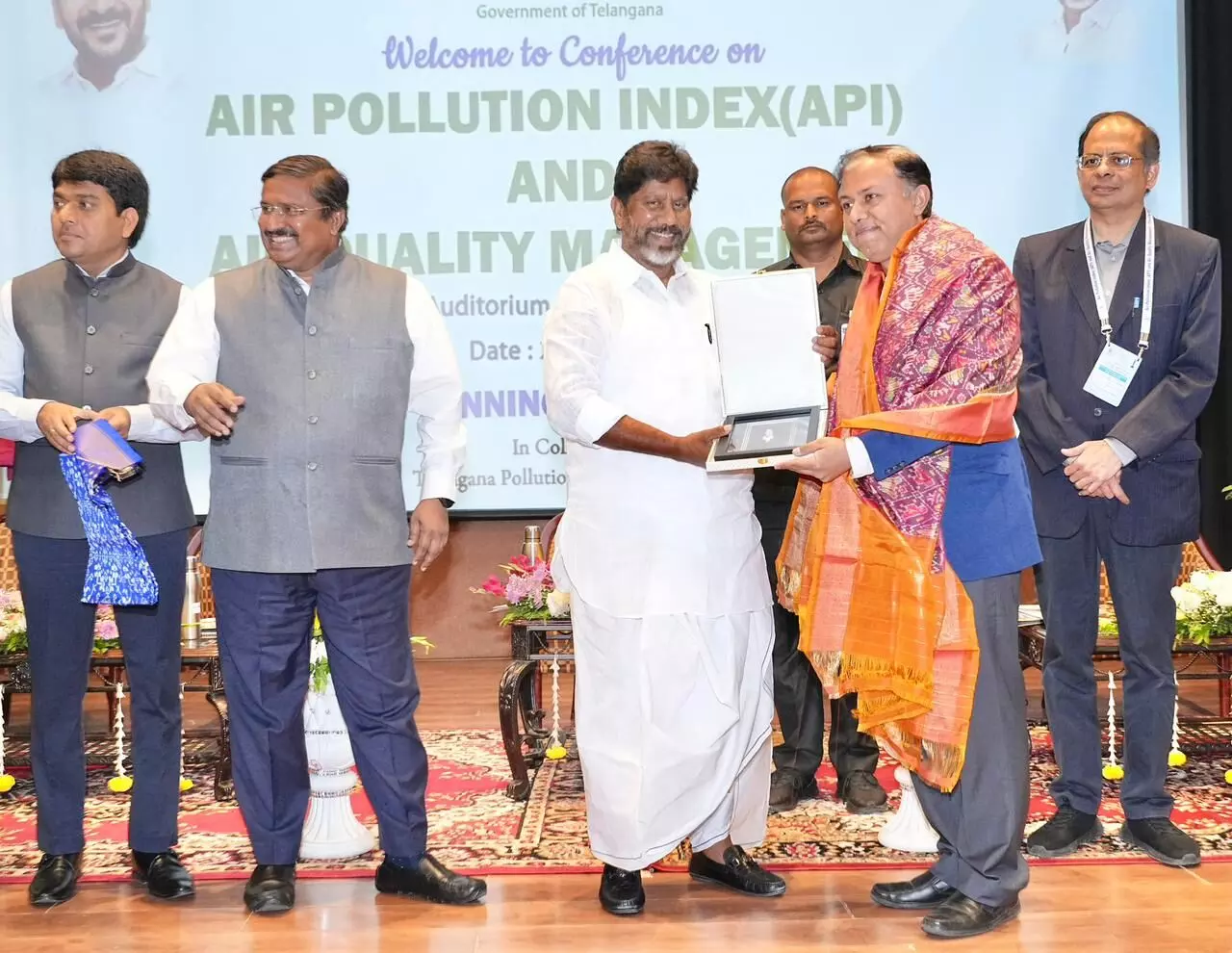
Poor air quality impacts public health, productivity and economy: Telangana deputy chief minister Bhatti
Hyderabad: Emphasising that economic growth and environmental preservation must go hand in hand, Deputy Chief Minister Bhatti Vikramarka Mallu declared that the Telangana government is adopting a rigorous scientific approach to ensure ‘Clean Air for a Healthy Telangana.’
Speaking as the Chief Guest at a high-level conference on ‘Air Quality Index and Air Quality Management’ held at the Marri Channa Reddy Human Resource Development Institute (MCRHRD), the Deputy CM outlined a vision where the state’s goal of a three-trillion-dollar economy is anchored in sustainable development.
Air Quality: A triple indicator
Addressing experts and policymakers, Bhatti Vikramarka stressed that air quality is no longer just an environmental concern but a critical public health, productivity and economic indicator.
Citing the 2024 State of Global Air Report, he warned that air pollution has become the second leading cause of death globally, claiming over 8 million lives annually.
He further noted that the global economy loses over four trillion dollars every year due to pollution-related impacts.
“Development without clean air is not real progress; it is merely delayed damage,” the Deputy CM stated, reinforcing the Cabinet’s commitment under the leadership of Chief Minister Revanth Reddy.
A five-pillar strategy for change
The Deputy CM detailed a comprehensive, target-driven framework currently being implemented across the state:
Massive Monitoring: The state doubled its air quality monitoring network in 2024, adding 40 new stations to ensure real-time data transparency.
State Clean Air Action Plan (2025): A targeted plan focusing on road dust, construction and open burning is already in motion.
Clean Mobility: To reduce vehicular emissions, the government is incentivising electric vehicles (EVs), expanding e-bus fleets and the Metro and launching vehicle scrapping facilities for older, polluting models.
Industrial Regulation: All industrial emission monitors are now linked directly to Pollution Control Board servers for 24/7 surveillance.
Renewable Energy Powerhouse: Under the 2025 Renewable Energy Policy, Telangana aims to generate 20,000 MW by 2030 through solar, wind, and green hydrogen.
Zoning reforms and public safety
The conference highlighted a pressing urban challenge: industrial zones like Jeedimetla, once on the outskirts, are now surrounded by dense residential populations.
With industries contributing up to 32 per cent of pollution in certain areas, the Deputy CM called for urgent industrial restructuring and zoning reforms to prevent potential disasters and health crises.
Public Empowerment: The air quality dashboard
In a move toward greater transparency, the government announced the upcoming launch of a Public Air Quality Dashboard. Additionally, the state will pilot Special Response Teams in two GHMC (Greater Hyderabad Municipal Corporation) zones to act swiftly on pollution-related complaints from citizens.
A call to action
Closing his address, the Deputy CM issued a challenge to the citizens of Telangana, asking whether they want the state to be a ‘wealthy region with polluted lungs’ or a ‘modern state with healthy citizens.’
He urged residents to make small daily choices—using public transport and avoiding waste burning—noting that the government cannot achieve these goals alone.
“Let us build a Telangana where economic growth and clean air move forward together. That will be our true legacy,” he said.


