Iran-Israel-US war: Caught in middle, Andhra migrant narrates ordeal after missile hits Abu Dhabi
The fear of being trapped in a collapsing building has forced many workers to abandon their indoor accommodations. They believe that being in the open offers a better chance of running if a direct hit occurs.
By - Rajeswari Parasa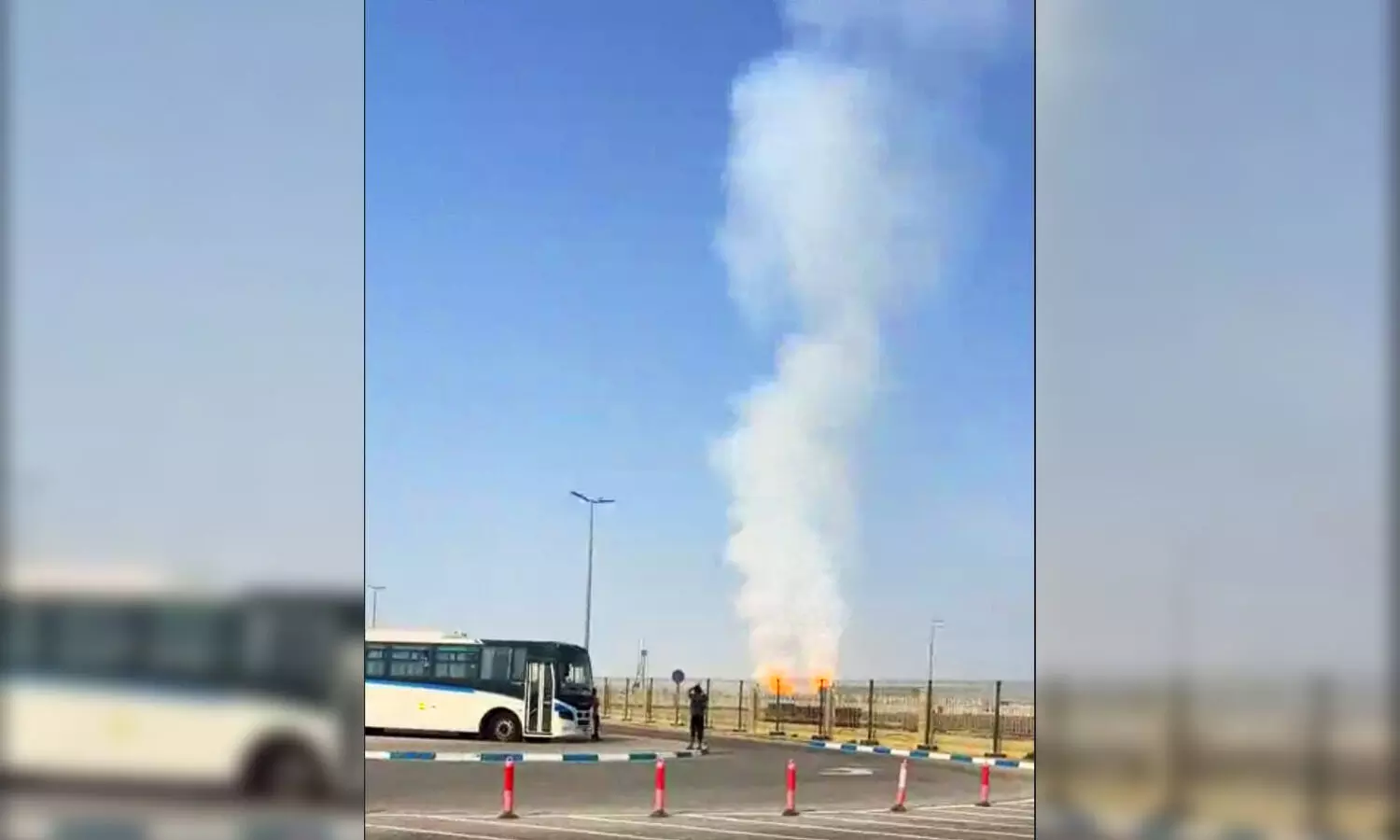
Hyderabad: "A missile fell just 500 meters away; an oil plant was blasted, and it’s all gone. At this distance, you can see the thick smoke. When the missiles hit, the ground shakes beneath our feet. The sound is constant 'boom boom,' and it is terrifying. Yesterday alone, we were told that 237 missiles were fired. We see the anti-defense missiles launching from right next to our campsite; the whole sky is filled with clouds of smoke," said Ramesh Ravuri, a resident of Andhra Pradesh who works as a mechanical supervisor in a crude oil factory, and is one of those caught in the crossfire
Ravuri left for the UAE only 15 days ago after his family vacation. He has been settled in Dubai for the last 18 years. This time, he also took six other friends along with him, who were hoping for a better life. Instead, they all found themselves in a nightmare.
Speaking to NewsMeter from Abu Dhabi, Ramesh narrated the ordeal of migrant workers.
Tension at home
Back home in Andhra Pradesh, his wife, Swathi, said there is so much tension and fear. Bombings are reported everywhere, and all flights have stopped.
“It feels like no place is truly safe. My husband returned to Abu Dhabi only fifteen days ago. Now he is caught in the middle, forced out in the night. I can’t sleep, and I am overwhelmed with emotion, knowing he is in the city where everything is a target. The only hope is to stay outside and be ready to run,” she said.
The crisis and the chaos
The Middle East has been plunged into a war-after US and Israel attacked Iran. Targeted strikes are being launched against strategic infrastructure and military hubs across ten countries, including the UAE, Qatar, and Kuwait.
As a result, major aviation hubs have been paralyzed, and airspace has been suspended across West Asia, leaving thousands of foreign nationals stranded.
The strategy for survival
The fear of being trapped in a collapsing building has forced many workers to abandon their indoor accommodations. They believe that being in the open offers a better chance of running if a direct hit occurs.
"We are mostly staying outside right now because if you are inside a building and a missile comes, we won't have a clue; it is too difficult to escape. We just sit out here, even at night. But how long can you sit outside? We don’t know," Ramesh said.
The psychological burden
The psychological burden of the uncertainty is heavy. For Ramesh and the 3,000 other workers in his camp from various countries, the speed of modern warfare leaves no room for error or escape.
"I am just stuck in this room, gripping in fear. When my family calls and says they are sad, it makes it even harder. You think about running away, but these rockets travel at jet speed; what takes a flight four hours, they cover in 30 minutes. There is no time to react. You just watch the drones and the missiles and hope the defense system hits them before they find you," said Ramesh.
"It’s a strange situation; there are people posting videos on TikTok like they have no fear at all. We are told not to share videos because of the alerts and cyber laws. We are constantly seeing the lights and the sounds coming from the missiles. For those of us living next to the targets, it’s a nightmare," Ramesh narrated.
From the safest city to the war zone
The shift from being a safe city to a targeted zone happened almost overnight. As military bases and industrial plants become the focus of attacks, the sense of security has evaporated.
"They are targeting the air bases and the big plants, even an Amazon godown nearby was hit. Abu Dhabi was once considered the safest city in the world, but because of the US military bases here, we are now in the middle of a war zone. They are firing at everything: ports, gas plants, and oil facilities. We are just 3,000 workers in a camp, living right next to the targets, watching the fire burn since morning," Ramesh added.
Indian government’s advisory
Meanwhile, back in India, the government is taking steps to assist those affected by the regional instability. All foreign nationals in India who have had to change their travel plans due to the ongoing developments in West Asia and need assistance with visa extensions or to regularize their stay are requested to contact the nearest Foreigners Regional Registration Office (FRRO).
The FRRO concerned will help with the necessary formalities. For contact details of the FRRO, you may visit https://boi.gov.in/.
While local communities are coming together to help those stranded, for wives like Swathi, the only relief will come when the airspace reopens, and their loved ones are back on safe ground.


