Telangana rolls out Vehicle Scrapping Policy to scrap unfit and high-emission vehicles
The policy is aimed at systematically phasing out old, unfit and high-emission vehicles, while simultaneously modernising the state’s transport ecosystem through technology-driven reforms.
By - Sistla Dakshina Murthy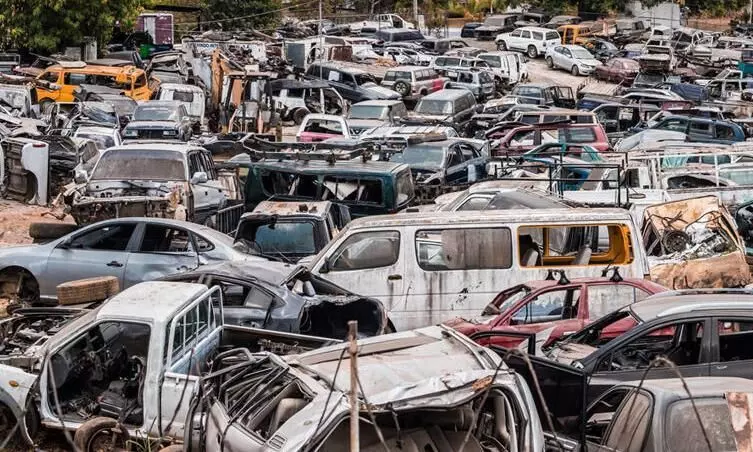
Representational Image
Hyderabad: To prevent Hyderabad from sliding into a severe air pollution crisis like Delhi, the Telangana government has launched a comprehensive Vehicle Scrapping Policy.
The policy is aimed at systematically phasing out old, unfit and high-emission vehicles, while simultaneously modernising the state’s transport ecosystem through technology-driven reforms.
Incentives to private and development of scrapping facilities
The policy is being backed by incentives for private investment in authorised scrapping facilities and a parallel push for electric, CNG and LPG vehicles to ensure a cleaner transition, said Special Chief Secretary (TR&B) Vikas Raj.
He was speaking at the Green Mobility 2047: Zero Emission Vehicles session organised by the Telangana Transport Department at Telangana Global Rising Summit at Bharat Future City, Hyderabad, on Monday.
Retiring old and high-emission vehicles
Elaborating further, Vikas Raj said the scrapping policy will focus on removing ageing vehicles that have outlived their fitness and are contributing disproportionately to air and noise pollution.
A network of authorised vehicle scrapping centres is being developed with private sector participation to ensure scientific dismantling, recycling and disposal, he added.
Private players invited to build scrapping ecosystem
The government is encouraging entrepreneurs and infrastructure players to establish modern scrapping units across the state.
“This will create a regulated ecosystem that ensures safe disposal, recycling of valuable materials and environmental protection,” Vikas Raj said, adding that the initiative will also generate employment.
State offering free registration for EVs
The scrapping policy will work in tandem with Telangana’s Electric Vehicle Policy, under which the state is offering free registration for EVs. EV adoption across two-wheelers, three-wheelers, passenger cars and goods vehicles has steadily increased, with penetration now reaching nearly 2 per cent, he said.
CNG and LPG vehicles to replace polluting autos
In addition to EVs, the government is promoting CNG and LPG vehicles, particularly in the auto-rickshaw and three-wheeler segment, to gradually phase out petrol and diesel autos that are major urban polluters.
Automated driving tests to end human interface
As part of broader transport reforms, the state is introducing fully automated driving test tracks, which will assess applicants without human interference. Aspirants will complete tests on computerised tracks and receive instant results, improving transparency and efficiency.
ANPR cameras, ITS to strengthen traffic management
The deployment of Automatic Number Plate Recognition (ANPR) cameras has strengthened traffic enforcement by detecting violations automatically without stopping vehicles.
This forms a core component of the state’s developing Intelligent Transport System (ITS) for real-time traffic monitoring and safer roads.
Border check posts removed for seamless travel
The state has also abolished all border check posts to ensure smooth interstate movement for commuters. Only vehicles requiring special permits are now identified electronically through camera-based surveillance, minimising delays and congestion.
Technology to make transport citizen-friendly
From driving licences to vehicle registration and renewals, the Transport Department is moving towards fully contactless, transparent and automated services, significantly reducing public inconvenience, the Special Chief Secretary said.


