Conversion beyond Hinduism, Sikhism or Buddhism ends SC status, rules Supreme Court
The apex court affirmed that the constitutional provisions and statutory safeguards available to SC communities cease to apply once a person no longer falls within the definition outlined in law.
By Sistla Dakshina Murthy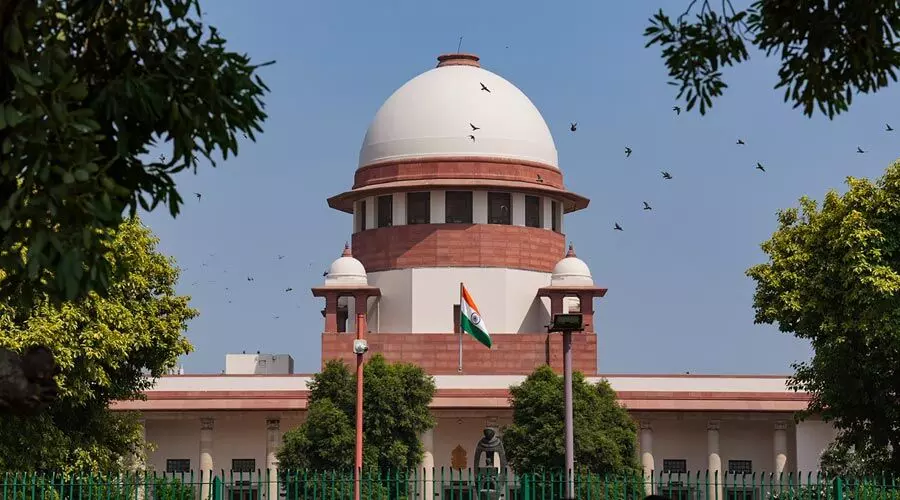
File Photo
New Delhi: The Supreme Court on Tuesday ruled that a person who converts to a religion other than Hinduism, Sikhism or Buddhism cannot be considered a member of a Scheduled Caste (SC), holding that such conversion leads to an immediate and complete loss of SC status under the law.
Top court upholds AP High Court order
A bench of Justices, Prashant Kumar Mishra and NV Anjaria, upheld the April 30, 2025, judgment of the Andhra Pradesh High Court, which had ruled that individuals who convert to Christianity and actively practice the faith cannot claim benefits meant for Scheduled Castes.
The apex court affirmed that the constitutional provisions and statutory safeguards available to SC communities cease to apply once a person no longer falls within the definition outlined in law.
‘Bar is absolute, no dual claim possible’
The court made it clear that the restriction is absolute and does not allow for any exceptions.
“No statutory benefit, protection, reservation or entitlement can be claimed by a person who is not deemed to be a member of a Scheduled Caste,” the bench observed. It further stated that an individual cannot simultaneously profess a religion outside those specified and still claim SC status.
1950 Presidential order central to ruling
The court relied on Clause 3 of the Constitution (Scheduled Castes) Order, 1950, which limits SC status to individuals professing Hinduism, Sikhism or Buddhism.
It reiterated that conversion to any other religion results in the automatic loss of SC identity, regardless of a person’s caste by birth.
How did the case start?
The case arose from a petition filed by Chinthada Anand, a pastor from Andhra Pradesh, who challenged the High Court’s decision after it quashed criminal charges filed by him under the SC/ST (Prevention of Atrocities) Act.
Anand had alleged that he was assaulted and threatened by an individual, Akkala Rami Reddy, in 2021 while conducting Sunday prayers in a village. He claimed caste-based abuse and invoked provisions of the SC/ST Act.
Court notes continued practice of Christianity
The Supreme Court noted that Anand had been practising Christianity for over a decade and was functioning as a pastor, regularly conducting prayer meetings.
“It is not the case that the petitioner reconverted to his original religion or was accepted back into his community,” the bench observed, adding that evidence clearly showed he continued to profess Christianity at the time of the incident.
Christianity outside caste framework
Echoing the High Court’s reasoning, the apex court noted that the caste system is not recognised within Christianity, and therefore, individuals practising the religion cannot seek protection under laws meant for the Scheduled Castes.
Final verdict
With these observations, the Supreme Court dismissed the appeal and upheld the High Court’s order, reinforcing that SC status is strictly governed by religious criteria specified in the 1950 Presidential Order.


