SC clears AP one-man panel in Tirumala laddu ghee case, dismisses BJP leader Subramanian Swamy’s plea
The Bench, which also included Justice Joymalya Bagchi, observed that the court’s only concern was to ensure there was no overlap between the administrative inquiry and the SIT investigation.
By - Sistla Dakshina MurthyPublished on : 23 Feb 2026 5:16 PM IST
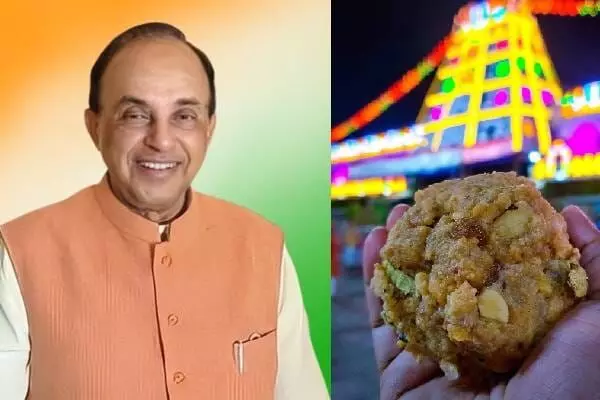
New Delhi: The Supreme Court on Monday dismissed BJP leader Subramanian Swamy’s petition challenging the Andhra Pradesh government’s decision to set up a one-man committee to examine administrative lapses in the alleged Tirumala laddu ghee adulteration case, ruling that the panel does not interfere with the court-monitored SIT probe.
A Bench headed by Chief Justice of India Surya Kant dismissed a writ petition filed by BJP leader Subramanian Swamy, who had challenged the constitution of the panel on the ground that it would interfere with the Special Investigation Team (SIT) probe ordered by the apex court.
Administrative inquiry, criminal probe operate separately
The Bench, which also included Justice Joymalya Bagchi, observed that the court’s only concern was to ensure there was no overlap between the administrative inquiry and the SIT investigation.
The judges made it clear that the state government’s departmental review is confined to governance and administrative accountability, while the SIT probe pertains to criminal liability.
Finding no merit in the petitioner’s arguments, the court said there was no foundational basis for judicial intervention and directed that both processes continue strictly in accordance with law.
State says plea meant to stall proceedings
Appearing for the Andhra Pradesh government, senior advocate Sidharth Luthra argued that the petition had been filed with mala fide intent to derail departmental action against erring officials.
The state Cabinet, chaired by Chief Minister N. Chandrababu Naidu, had on February 3 approved the formation of a one-man committee to examine administrative lapses connected to the ghee procurement process for Tirumala laddus.
Retired IAS officer Dinesh Kumar was appointed to head the panel.
Panel’s mandate and timeline
According to the Government Order (GO), the committee has been tasked with examining the Self-Contained Note (SCN) submitted by the SIT and recommending appropriate departmental action against members and senior officials of the Tirumala Tirupati Devasthanams (TTD) for lapses in enforcement or relaxation of ghee tender conditions.
The committee has been directed to submit its report within 45 days. Its scope is limited to administrative responsibility, procedural compliance and governance issues, and does not extend to criminal findings.
SIT findings and charge sheet
Earlier, on October 4, 2024, the Supreme Court had entrusted the probe into the alleged adulteration of Tirupati laddus to an independent SIT under the supervision of the Director of the Central Bureau of Investigation.
The CBI-led SIT completed its investigation and filed a final charge sheet before an Anti-Corruption Bureau court in Nellore on January 23, 2026. It also submitted an SCN recommending administrative action against certain officials.
The charge sheet referred to tests conducted by the ICAR–National Dairy Research Institute in Karnal on four sealed ghee samples drawn in July 2024. While no lard or animal fat was detected, investigators concluded that the ghee was adulterated with a blend of vegetable oils and synthetic esters designed to mimic dairy characteristics.
ED probes financial angle
Separately, the Enforcement Directorate has registered an Enforcement Case Information Report (ECIR) under the Prevention of Money Laundering Act to examine alleged financial irregularities linked to the case.
The ED’s probe stems from the SIT charge sheet and focuses on suspected hawala transactions allegedly used by private dairy firms and intermediaries to route bribes to TTD officials involved in tender approvals and quality clearances.
With the Supreme Court declining to halt the state’s administrative review, both the departmental inquiry and the criminal investigations will now proceed in parallel.
Next Story


