Telangana doubled its cultivated area in decade, says Economic Survey; Kaleshwaram, Mission Kakatiya praised
Economic Survey highlights Telangana’s agricultural growth, praises Kaleshwaram and Mission Kakatiya
By - Kaniza Garari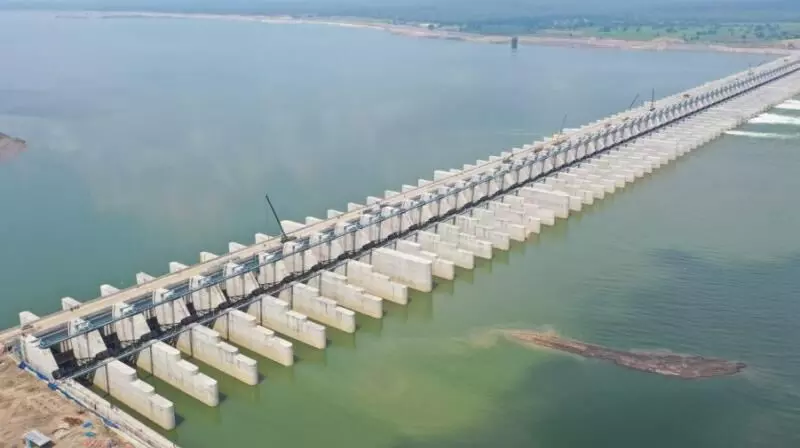
Economic Survey highlights Telangana’s agricultural growth, praises Kaleshwaram and Mission Kakatiya
New Delhi/Hyderabad: The Central Government’s Economic Survey 2026 has identified Telangana as a national leader in agricultural transformation, praising the state for its unique blend of massive engineering feats and traditional water conservation.
The survey highlights that Telangana has effectively doubled its cultivated area in just over a decade, growing from 1.31 crore acres in 2014 to 2.21 crore acres in 2025-26. This was possible due to the Kaleshwaram Lift Irrigation Project (KLIP) and Mission Kakatiya, the report said.
Key highlights from the survey about Telangana:
1. Synergy of KLIP and Mission Kakatiya: The report lauds the Kaleshwaram Lift Irrigation Project (KLIP) for overcoming topographical barriers to bring water to high-altitude regions.
Simultaneously, it credits Mission Kakatiya with revitalising over 46,000 tanks, which acted as the ‘last-mile connectivity’ for water distribution and groundwater recharge.
2. The ‘Paddy Revolution’: Owing to year-round water availability, Telangana has emerged as a top contributor to the national foodgrain pool, stabilising India’s food security despite erratic monsoon patterns elsewhere.
3. Digital Land Reforms (Bhu Bharati): The survey specifically appreciated the current Congress government’s Bhu Bharati portal. It noted that by integrating Revenue, Stamps and Registration departments into one transparent digital platform, the state has provided ‘secure, transferable property rights’ essential for land to function as capital.
4. Supply Chain Innovation: Telangana was recognised as one of the six states to fully implement the GPS-based Vehicle Location Tracking System (Anna Chakra) to monitor the real-time movement of foodgrains, significantly reducing leakages.
5. Industrial Inclusivity: The state received a special mention for removing restrictions on women working in a wider range of industries and streamlining fire safety regulations through third-party accredited agencies.
What is the Bhu Bharati portal?
- The 11-Digit Bhudhaar ID
The report highlights the introduction of Bhudhaar—a unique 11-digit identification number for every land parcel.
Much like an Aadhaar card for land, it provides a permanent digital identity to each plot, making it nearly impossible to commit duplication or identity fraud.
- Enhanced Pahani Records
The survey appreciates the restoration of detailed land records. While the previous system (Dharani) was criticised for being too minimal, Bhu Bharati expanded the digital Pahani to include 11 critical columns, capturing historical ownership, current cultivator details and land use patterns.
- GIS-Based Mapping
The Central Government lauded the use of drones and satellite-based rovers to create centimetre-accurate maps. These GIS-mapped records are now accessible online, allowing buyers to verify the exact boundaries of a plot before purchasing.
The Central government appreciated that for urban buyers, the portal’s integration with the IGRS (Registration) system has reduced the risk of ‘double registration’ and hidden encumbrances, boosting investor confidence in the Telangana real estate market.
District-wise impact of policies
The Economic Survey 2026 provides a granular look at how these state-wide policies translated into district-level prosperity:
1. Northern Telangana (The KLIP Heartland)
Rajanna Sircilla and Karimnagar: These districts witnessed the most dramatic rise in groundwater levels (5–10 meters). The Mid-Manair and Lower Manair dams now serve as permanent water sources, allowing farmers to cultivate up to three crops a year.
Jagtial and Nirmal: Access to stable irrigation led to a 40 per cent increase in paddy and maize production, shifting the local economy away from subsistence farming to high-yield commercial agriculture.
2. Central and Eastern Telangana
Siddipet and Medak: The creation of the Konda Pochamma Sagar and Mallanna Sagar reservoirs has turned previously semi-arid zones into fertile belts, sparking a boom in the local dairy and fisheries sectors.
Jayashankar Bhupalpally: As the host of the Medigadda pumping station, this district has seen over 1.5 lakh acres of land stabilised, providing a safety net for farmers formerly at the mercy of drought.
3. Southern Telangana
Nalgonda and Mahabubnagar: Once the ‘drought capital’ of the state, these districts are now the primary beneficiaries of the tank restoration program. The revitalisation of over 8,000 tanks has significantly lowered fluoride levels in groundwater and improved soil fertility, the report said.
Warangal (Rural & Urban): The restoration of heritage tanks like Ramappa and Pakhal has not only secured irrigation but has provided livelihoods for over 50,000 fishermen, boosting the rural blue economy.


