Urban reforms, green policies central to Telangana Rising 2047 vision: Governor Jishnu Dev
Highlighting governance reforms, the Governor said the Greater Hyderabad Municipal Corporation was expanded by merging 27 municipalities within the CURE region.
By - Newsmeter Network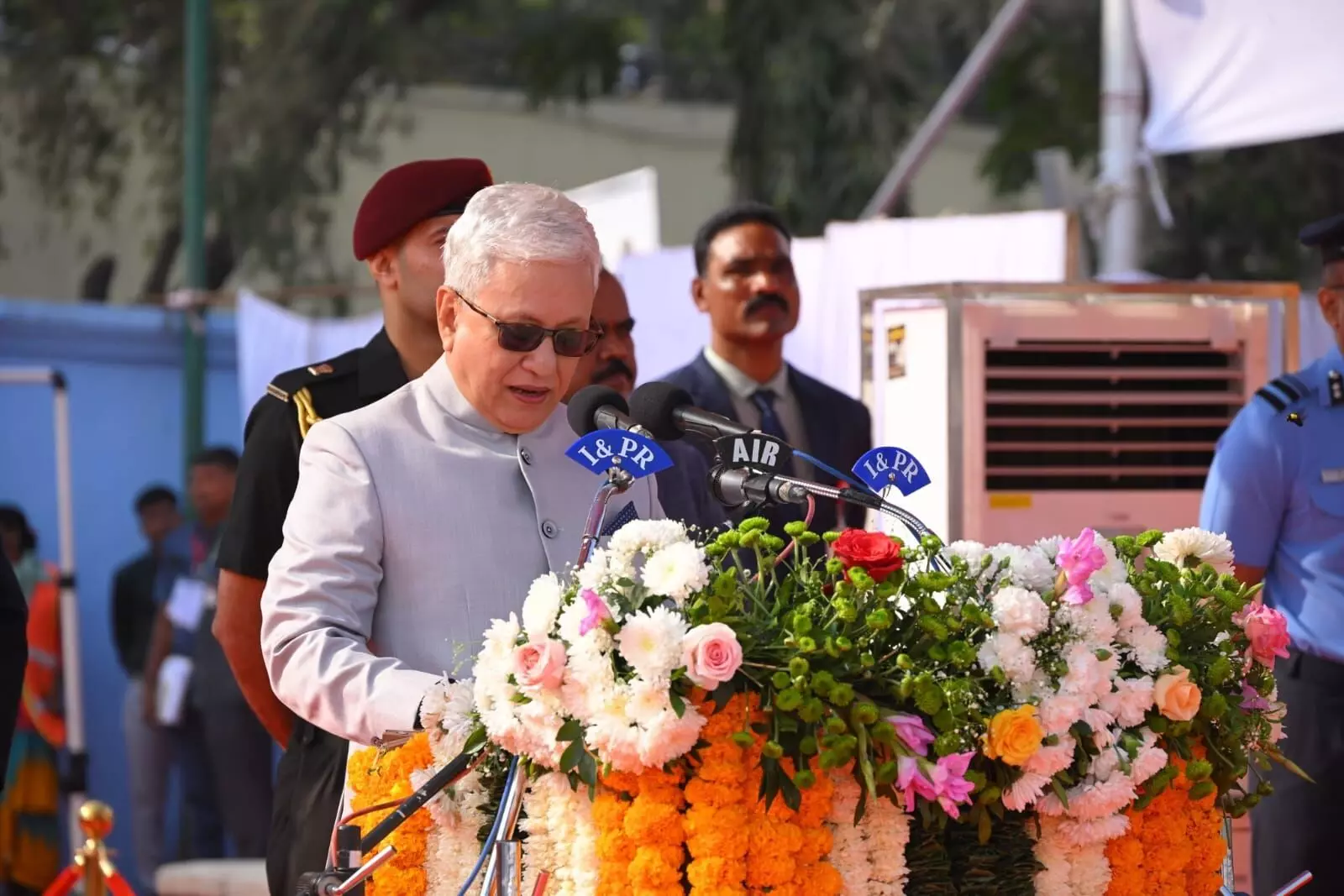
Hyderabad: Unveiling an ambitious blueprint to transform Telangana into a major growth engine for the country, Governor Jishnu Dev Varma on Monday said the Telangana Rising Vision 2047 aims to reposition the State as a key driver of India’s progress by the time the nation marks 100 years of Independence.
Addressing the 77th Republic Day celebrations after hoisting the national flag at the Secunderabad Parade Grounds, the Governor said the vision document, released on the completion of two years of the present government, provides a comprehensive roadmap for inclusive, sustainable and high-growth development.
Ambition of a $3 trillion economy
Under Vision 2047, Telangana has set itself the ambitious goal of becoming a $3 trillion economy. The strategy, the Governor said, is anchored in long-term planning, infrastructure expansion, industrial growth and balanced regional development.
Three-zone economic framework
The vision document divides the State’s development into three distinct economic zones:
- Core Urban Region Economy (CURE): With Hyderabad as the growth engine.
- Peri-Urban Region Economy (PURE): The area between the Outer Ring Road (ORR) and the Regional Ring Road (RRR), focusing on manufacturing and industrial expansion.
- Rural Agriculture Regional Economy (RARE): Regions beyond the RRR, centred on agriculture, green economy initiatives and agri-based enterprises.
Major infrastructure projects
Key initiatives under Vision 2047 include the Gandhi Sarovar project at Bapu Ghat, greenfield highways, dry ports, Phase-II of the Metro Rail, radial roads connecting the ORR and RRR, and proposed airports at Warangal and Adilabad.
Industrial corridors linking Hyderabad with Nagpur, Bengaluru and Vijayawada are also planned.
Urban governance reforms
Highlighting governance reforms, the Governor said the Greater Hyderabad Municipal Corporation was expanded by merging 27 municipalities within the CURE region.
This increased its jurisdiction from 650 sq km to 2,053 sq km. The GHMC has also been reorganised into 300 wards, 60 circles and 12 zones to ensure more efficient civic administration.
Strengthening law and order
To enhance public safety, three new police commissionerates have been created in the CURE region, along with one commissionerate in the proposed Future City area.
Pollution control and green policies
Several measures have been initiated to reduce pollution in the core urban area, including a 100 per cent exemption on road tax and registration fees for electric vehicles.
The Hyderabad Industrial Land Transformation (HILT) policy aims to relocate polluting industries beyond the ORR, while allowing landowners to convert their sites for multi-use development.
Bharat Future City
The Governor highlighted Bharat Future City, a 30,000-acre greenfield urban project envisioned as India’s first Net Zero Smart City. It is located at Mucherla and Kandukur, south of Hyderabad, between the Srisailam and Nagarjunasagar highways.
The project will include an AI City, Young India Skills University, a Health City focused on medical tourism and a large sports hub. Sustainability, forest cover and ‘walk-to-work’ townships form the core of its design.
Musi Riverfront development
The Musi Riverfront Development Corporation Limited has prepared a master plan to develop a 55-km stretch of the Musi River, covering Osman Sagar to Gowrelli (ORR East) and Himayath Sagar to Gandhi Sarovar at Bapu Ghat.
Protecting water bodies
To curb encroachments on tanks and water bodies and improve disaster preparedness, the Hyderabad Disaster Response and Assets Protection Agency (HYDRAA) has been brought into force.
Road infrastructure upgrade
The government plans to upgrade 12,000 km of Roads and Buildings (R&B) roads under the Hybrid Annuity Model (HAM).
Phase I, with an allocation of Rs 11,399 crore, will be completed within 30 months. Additionally, 7,450 km of Panchayat Raj roads will be upgraded at an estimated cost of Rs 16,007 crore.
Hyderabad as a global hub
The Governor said Hyderabad continues to strengthen its position as a global investment destination, hosting nearly 20 per cent of India’s Global Capability Centres (GCCs), further enhancing its international profile.
The Telangana Rising Vision 2047, the Governor concluded, reflects the State’s determination to pursue sustainable growth, balanced regional development and global competitiveness over the next two decades.


