Record participation marks 79th IIM Annual Technical Meeting as global experts gather at IIT Hyderabad
Speakers and participants have joined from India, Australia, Japan, Germany, the USA, South Africa, and France
By - Newsmeter Network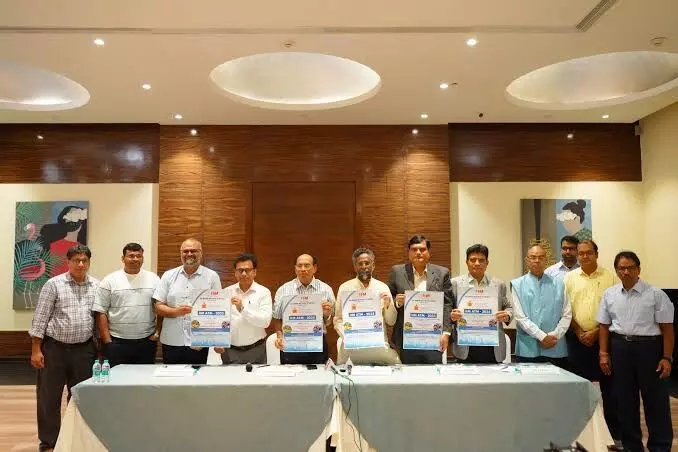
Hyderabad: The 79th Annual Technical Meeting (ATM) of the Indian Institute of Metals (IIM) is currently underway at IIT Hyderabad, drawing national and international experts in metallurgy, materials science, and critical mineral technologies.
The three-day event, which began on 4 December, opened with the International Conference on Advanced Materials and Critical Minerals for Energy Transition, aligning with India’s energy transition and technological advancement goals.
Record participation and international presence
This year marks a milestone for IIM ATM, registering the highest-ever participation with more than 1,400 abstract submissions for oral and poster presentations and over 100 metallography micrographs. Speakers and participants have joined from India, Australia, Japan, Germany, the USA, South Africa, and France.
A major technical exhibition featuring advanced characterisation equipment and manufacturing technologies from 45 institutes was also inaugurated by N. Balaram, Chairman and Managing Director, Singareni Collieries Company Limited (SCCL).
Inaugural day highlights: Plenary sessions and technical tracks
The opening day featured 24 plenary talks delivered across two parallel sessions.
The Advanced Materials track covered themes such as alloy design, advanced energy materials, novel alloy processing, and quantum materials.
The Critical Minerals track focused on mineral resources, beneficiation technologies, extraction processes, refining, and recycling of strategic metals.
Decarbonisation and critical mineral strategy
Presiding over the inaugural ceremony, Prof. B. S. Murty, Director of IIT Hyderabad and President of IIM, outlined the central theme of the conference.
He highlighted India’s push toward material independence, stating:
“The global imperative to decarbonize demands accelerated development of materials with superior functional properties and processing of critical minerals. The future of technologically self-reliant India hinges on our ability to master the complete life-cycle of critical elements, from responsible sourcing and advanced beneficiation to sophisticated materials processing and next-generation manufacturing technologies.”
Industry perspective: sustainable and efficient processes
Dr. Komal Kapoor, Senior Vice-President of IIM and Chairman and Managing Director of Nuclear Fuel Complex (NFC), underlined how material demands are intensifying with national priorities.
He said: “The urgency in intensifying material demands for energy transition, strategic national needs and sustainable requirements is clear. The future of metallurgical industries will be defined by sustainable production and technological integration. The success hinges on embracing energy-efficient processes, reducing waste, and utilising renewable materials.”
Speaker selection and scientific direction
Dr. Tata Narasinga Rao, Vice Chancellor of Sri Venkateswara University (SVU), Tirupati, and Co-Convenor of IIM ATM 2025, discussed how distinguished speakers were selected for the programme.
He “gave detailed procedures followed in the selection of distinguished speakers covering all areas of advanced materials and critical minerals.”
Government’s view on critical minerals
Chief Guest N. Balaram highlighted the strategic significance of critical materials in India’s energy sector.
He spoke about: “the role of critical materials in energy production” and outlined government initiatives to strengthen domestic production of critical minerals.
Platform for knowledge exchange and collaboration
Prof. K. Bhanu Sankara Rao, Convenor of IIM ATM 2025 and Professor of Practice at IIT Hyderabad, noted that the event is designed to foster collaboration among stakeholders shaping India’s material ecosystem.
He said: “The event serves as a platform to foster collaboration and knowledge sharing among leading industry experts, researchers, academicians and thought leaders. The future of technological growth of India to realise ‘Atmanirbar Bharath’ depends on our ability to master the life cycle of critical elements, consisting of sourcing, beneficiation, materials processing and next-generation manufacturing technologies.”
He added that subject experts from several countries are leading discussions across all major areas of the conference.
Conclusion
As the 79th IIM Annual Technical Meeting enters its final day, the discussions at IIT Hyderabad underscore India’s increasing focus on advanced materials, sustainable technologies, and critical minerals. With record participation and contributions from global experts, the event continues to reinforce India’s expanding role in materials research and technological self-reliance.


