Transport drives 23% of Telangana’s emissions, experts call for stronger EV regulations
Despite the state recording an impressive 9 per cent annual growth in vehicle sales – nearly three times the national average of 3.32 per cent – EV penetration continues to lag behind its potential.
By - Sistla Dakshina Murthy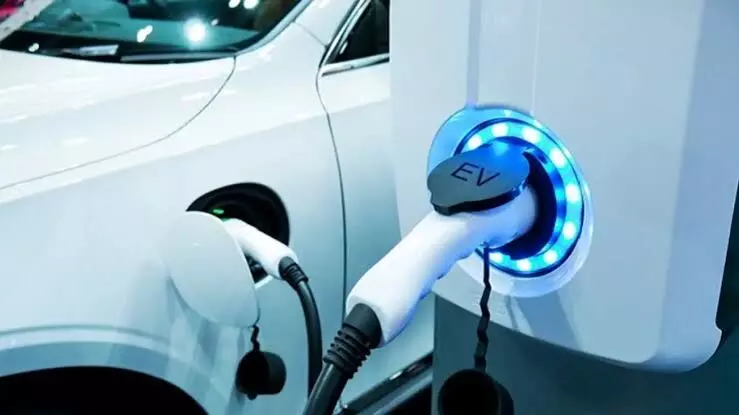
Representational Image
Hyderabad: Experts have underlined the urgent need to accelerate the transition to Zero Emission Vehicles (ZEVs), said NRDC India Director (Clean Transportation and Industries) Nitish Arora.
This is crucial in light of data that states that the energy sector accounts for nearly 85 per cent of Telangana’s total greenhouse gas emissions, with transport alone contributing 23 per cent.
Maximum sales, minimum EV penetration
Despite the state recording an impressive 9 per cent annual growth in vehicle sales – nearly three times the national average of 3.32 per cent – EV penetration continues to lag behind its potential.
Nitish Arora was speaking at the Green Mobility 2047: Zero Emission Vehicles session organised by the Telangana Transport Department at Telangana Global Rising Summit at Bharat Future City, Hyderabad, on Monday.
From incentives to industry-building: Telangana’s 2019 policy shift
Reflecting on the launch of Telangana’s EV policy in 2019, Nitish Arora noted that the state faced a critical choice: whether to rely solely on demand-side purchase incentives or adopt a long-term supply-side industrial strategy.
Telangana chose the latter, focusing on building a strong local manufacturing ecosystem.
As a result, the state has today emerged as a new automotive manufacturing powerhouse, with investments flowing across the EV value chain—from battery production to vehicle assembly.
Four major barriers are slowing ZEV adoption
However, the ZEV transition continues to face four structural roadblocks:
1. Automaker Constraints (OEMs): Limited visible market demand, supply chain bottlenecks for key components and inadequate charging infrastructure.
2. Charging Operators’ Dilemma: Low utilisation of stations, policy uncertainty and parallel approvals for petrol pumps and gas stations affecting investor confidence.
3. Consumer Concerns: High vehicle prices, limited model options, charging anxiety and uncertainty over battery life and resale value.
4. Fiscal Sustainability: Governments cannot indefinitely sustain purchase subsidies.
Beyond subsidies: Rethinking the EV growth strategy
With fiscal incentives nearing practical limits, the focus is shifting to alternative policy tools.
Experts stressed the need to:
- Continue targeted incentives for medium and heavy-duty vehicles
- Begin a phased transition away from ICE vehicles
- Deploy blended finance mechanisms to scale up EV adoption
- Integrate demand-side regulations with supply-side policies
Power sector readiness crucial for charging expansion
While Telangana has aggressively promoted EV manufacturing, experts pointed out that investments in power utilities must keep pace to make the grid EV-ready. Without adequate power infrastructure, the expansion of public charging stations will remain constrained.
Fleet electrification to drive early mass adoption
High-usage segments such as ride-hailing services, e-commerce and logistics fleets are seen as the most effective early drivers of EV adoption. However, operators in these sectors continue to flag high upfront vehicle costs and insufficient charging access as major hurdles.
Supply-side regulations: Lessons from global markets
Globally, more than 29 countries have introduced firm ZEV mandates or ICE phase-out targets.
Mature EV markets like the US, Europe and China have witnessed:
- 24% fall in EV prices in three years
- Price gap between EV and ICE vehicles shrinking to less than $2,000
- Massive private investments in charging networks
Notably, the UK mobilised nearly £6 billion in charging infrastructure investment after introducing supply-side regulations in 2024.
Market certainty drives investment, jobs and scale
Experts said supply-side regulations (SSRs) provide long-term market certainty, enabling higher production volumes, lower vehicle prices through economies of scale, stronger domestic supply chains and large-scale job creation in both manufacturing and charging infrastructure
ZEV mandates will not drive away investment
Dispelling fears that tight EV regulations may push investors to other states, experts asserted that clear and predictable policy frameworks attract investments. Global experience from the EV sector and other technology-led industries proves that policy certainty outweighs short-term cost concerns.
Telangana is at a defining inflection point
Experts said Telangana now stands at a critical inflection point.
Its early focus on supply-side policies has laid a strong industrial foundation. The next phase will require bold demand regulations, grid readiness and large-scale private investment in charging infrastructure to ensure the ZEV transition achieves irreversible momentum.


