‘Who governs the AI transformation?’ Experts debate jobs and rights at Hyderabad Press Club
Debates at Hyderabad Press Club about regulating AI’s growing influence on work and rights
By - Newsmeter Network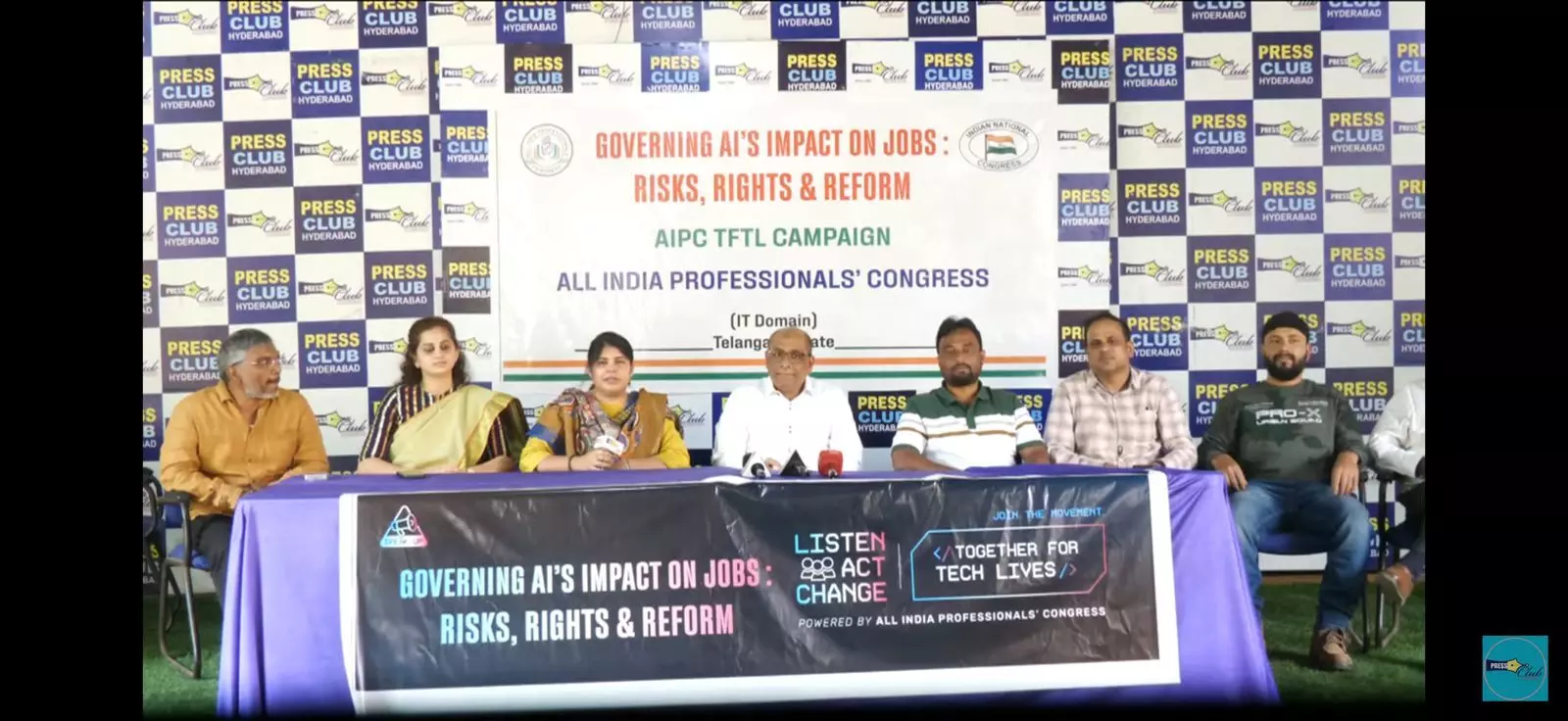
Debates at Hyderabad Press Club about regulating AI’s growing influence on work and rights
Hyderabad: Is AI an ‘Avatar’ of prosperity, or an ‘evil’ destined to consume the Indian job market? This is the question which is being debated in various circles.
To do away with the misconceptions, the All India Professional Congress had a debate organised titled ‘Governing AI’s Impact on Jobs: Risks, Rights & Reforms’, at the Press Club in Somajiguda.
‘Who governs the transformation?’
“Artificial Intelligence is no longer a futuristic concept. It is here. It is embedded in our workplaces, our hiring systems, our financial services, our hospitals, and even our governance structures. The question before us today is not whether AI will transform jobs — it already is. The real question is: Who governs this transformation, and in whose interest?” one of the speakers said.
The ‘diametrical shift’ in the economic model
The roundtable concluded with a call to action for policymakers to treat AI not just as a technological trend, but as a fundamental shift in the rights and livelihoods of the Indian citizen.
Irfan Aziz, Senior AIPC Executive and Media and Communication Dept. Co-Chair/Convenor of Telangana Pradesh Congress Committee (TPCC) challenged the audience to look beyond incremental changes.
He questioned whether the current economic framework is merely being ‘added to’ or if we are witnessing a total structural collapse of traditional employment. “Artificial Intelligence has become a household commodity, but we must ask: Is AI the new Avatar that brings prosperity and growth, or will it turn into an evil that eats away our jobs? We stand at a crossroads where the path to the future is often muddled and uncertain. To protect our future and build a growth story, we cannot rely on old maps; we need entirely new thinking to ride this wave,” he said.
The roundtable highlighted a sobering reality for India’s digital workforce.
With over 5 million people employed in the IT and BPO sectors, the ‘replacement risk’ is no longer theoretical. AI automation is rapidly eroding the need for entry-level programming, data entry, and customer support—the very roles that have fuelled India’s middle-class growth for decades.
Key impacts discussed include:
Job Polarisation: A widening chasm is forming between high-skill AI engineers and low-skill workers. While data science and cybersecurity roles are booming, the middle-tier workforce is being squeezed out.
The gig economy transition: Experts predicted a ‘diametrical shift’ where white-collar work moves from stable corporate employment to a global gig economy, with Indian professionals working as remote, independent agents for international firms.
Building the ‘growth story’ through reform
The session featured insights from Nitin Guna (IT Head, TG), Raghav (AIPC Member), and Maria Tabassum (Academia Vertical Deputy Head, TG), who emphasised that "protecting the future" requires more than just reskilling—it requires Governance.
The participants argued that for AI to be an ‘Avatar’ of growth rather than a disruptor, the government and industry must collaborate on:
Rights and Reforms: Establishing legal protections for workers in the emerging AI-driven gig economy.
Strategic Shielding: Implementing policies that encourage ‘Human-AI Collaboration’ rather than total replacement.
Educational Overhaul: Moving academia toward high-value specialised roles to prevent the ‘Job Eater’ scenario.
The consensus at Somajiguda was clear: the era of passive growth is over. As Irfan Aziz noted, the paths are currently ‘muddled,’ but through proactive governance and a shift in economic thinking, India can ensure that AI adds incremental value to its existing framework rather than dismantling it.
“The future of work must not be decided in closed boardrooms or opaque algorithms. It must be shaped through democratic dialogue — government, industry, and professionals together,” the attendees expressed.
The roundtable concluded with a call to action for policymakers to treat AI not just as a technological trend, but as a fundamental shift in the rights and livelihoods of the Indian citizen.


