Classroom challenge to patent rights: How a Telangana teacher built a student-friendly linguistics tool
Nayak’s first solution was a large wooden board designed with a specific structural formula, which he used as a classroom Teaching Learning Material (TLM)
By - Rajeswari Parasa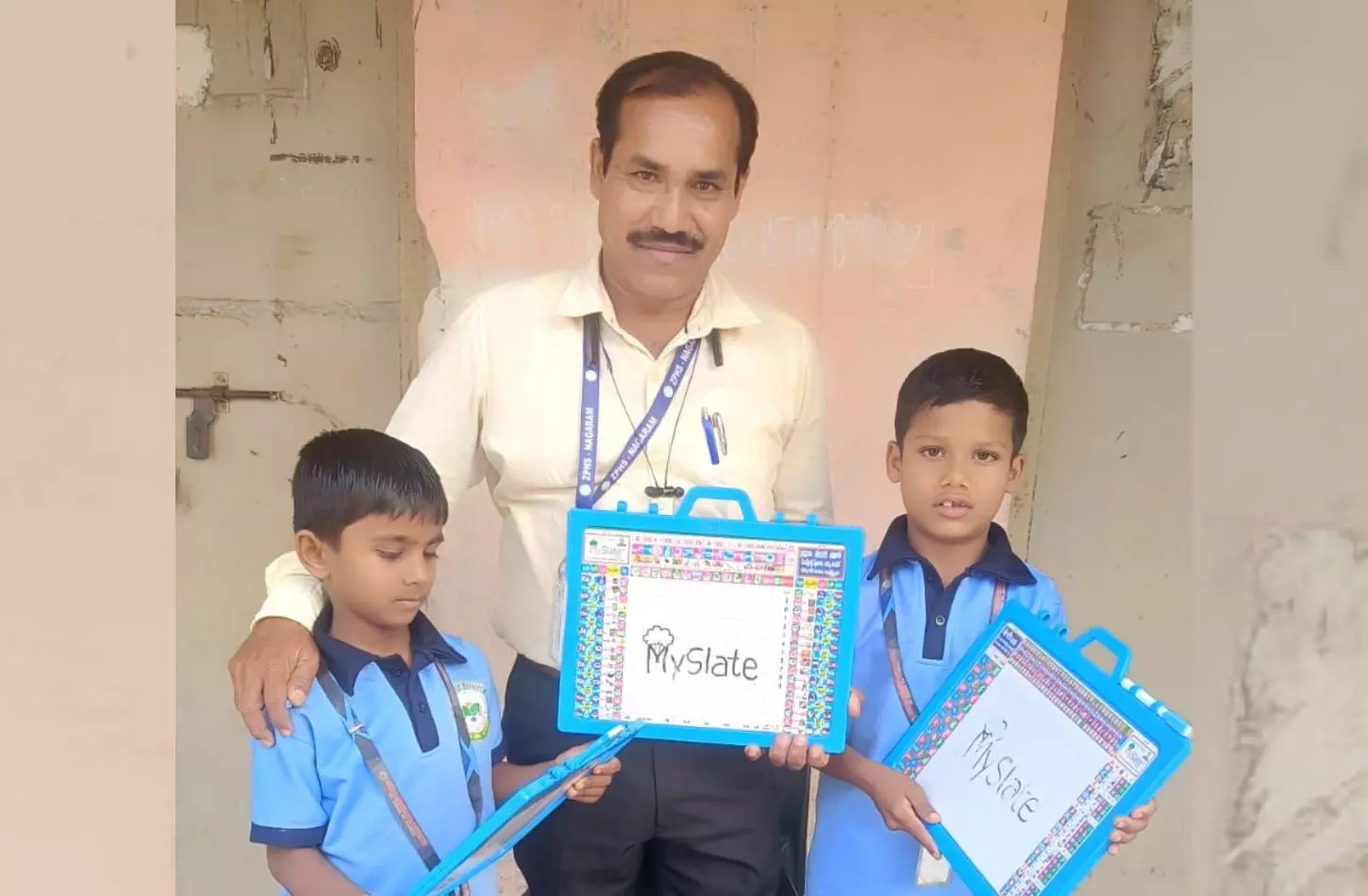
Classroom challenge to patent rights: How a Telangana teacher built a student-friendly linguistics tool
Hyderabad: In 2014, KT Nayak, a primary school teacher at a Mandal Parishad school at Pusthangi village in Telangana, faced a dilemma that defines the struggle of many educators.
Two of his second-grade students, Vaishnavi and Vishnu, were unable to grasp basic reading and writing. While he initially feared a learning defect, Nayak noticed the children were sharp and highly active during play.
“I realised the problem wasn’t their intelligence, it was the method of teaching,” Nayak recalls, speaking to the NewsMeter.
This sparked a decade-long journey that resulted in ‘My Slate’, a patented educational tool designed to simplify complex linguistics and lighten the physical and mental burden on young learners.
Starting from a wooden board
Nayak’s first solution was a large wooden board designed with a specific structural formula, which he used as a classroom Teaching Learning Material (TLM). The success was immediate and the struggling students finally began to read.
For years, the board remained a local success until Nayak was transferred to Zilla Parishad High School (ZPHS) in Edulanagulapally in 2018. Here, seeing sixth graders still struggling with foundational literacy, his colleagues suggested a radical change: shrinking the massive board into a portable slate.
With financial backing from Patancheru MLA Gudem Mahipal Reddy, Nayak produced 6,000 tablet-sized versions for distribution.
How does the slate work?
What makes ‘My Slate’ a patented innovation is its unique linguistic and mathematical layout. Unlike a traditional blank slate, this tool features a ‘formula-based’ border that surrounds a central writing space.
1. Phonetic Mapping: The slate maps Telugu sounds to English phonetic letters. It helps children understand how sounds transition between languages.
2. Integrated Mathematics: The middle section includes specialised boxes designed for quick calculations. It allows students to practice addition, multiplication and division within the same interface.
3. Multilingual Layout: One side focuses on Telugu and English, while the reverse side features Hindi and Telugu basics alongside the English alphabet and illustrative pictures.
The turning point and patent
The innovation gained significant momentum following an incident in Nizamabad, shares Nayak.
While visiting a lawyer for personal work, Nayak learned that the lawyer’s daughter, despite attending an international school, was struggling with reading. Nayak couriered his miniaturised slate to the family and guided the mother over the phone on how to use it by matching letters and sounds.
Within 20 to 25 days, the child learned to read.
Astonished by the results, the lawyer searched the internet and realised there was no existing patent for such a specific formula. He connected Nayak with a High Court lawyer to file for intellectual property rights.
Following this, Nayak showcased his innovation at various government TLM melas and district science exhibitions, eventually reaching the state-level exhibition in Nirmal in 2023, where he won an award. “Today, I hold the copyright, trademark, and a patent for the tool,” Nayak shared.
‘Learning should be light, not heavy’
Beyond pedagogy, Nayak is on a mission to reduce the physical toll on students. “Children today are carrying heavy bags, but they aren't necessarily carrying heavy knowledge,” Nayak says.
The slate weighs a mere 340 grams. Nayak argues that this single tool can replace multiple heavy textbooks for foundational learners. By practising activities using the letters and structures printed on the slate's border, children can learn through engagement rather than just rote memorisation from bulky books, explains Nayak.
‘Government schools are my priority’
“As a government teacher, my priority is not money; it is the underprivileged students,” Nayak asserts. “I want this to reach government schools first to maintain equality in education,” adds Nayak.
His commitment to social impact over commercial profit has caught the eye of high-level officials. Recently, Dr E Naveen Nicolas, IAS, Director of School Education, Telangana, officially recognised Nayak for aligning his tool with the Foundational Literacy and Numeracy (FLN) mission.
The innovation has also triggered interest from the Andhra Pradesh Education Department and State Academic Monitoring Officers, who are exploring ways to implement the slate on a larger scale.


