Don’t snatch keys or force citizens to pay pending Traffic challans: Telangana HC to cops
Citizens have the choice to pay the challan and if the police want to take action, then due process (court notice, etc.) must be followed, the court ruled
By - Newsmeter Network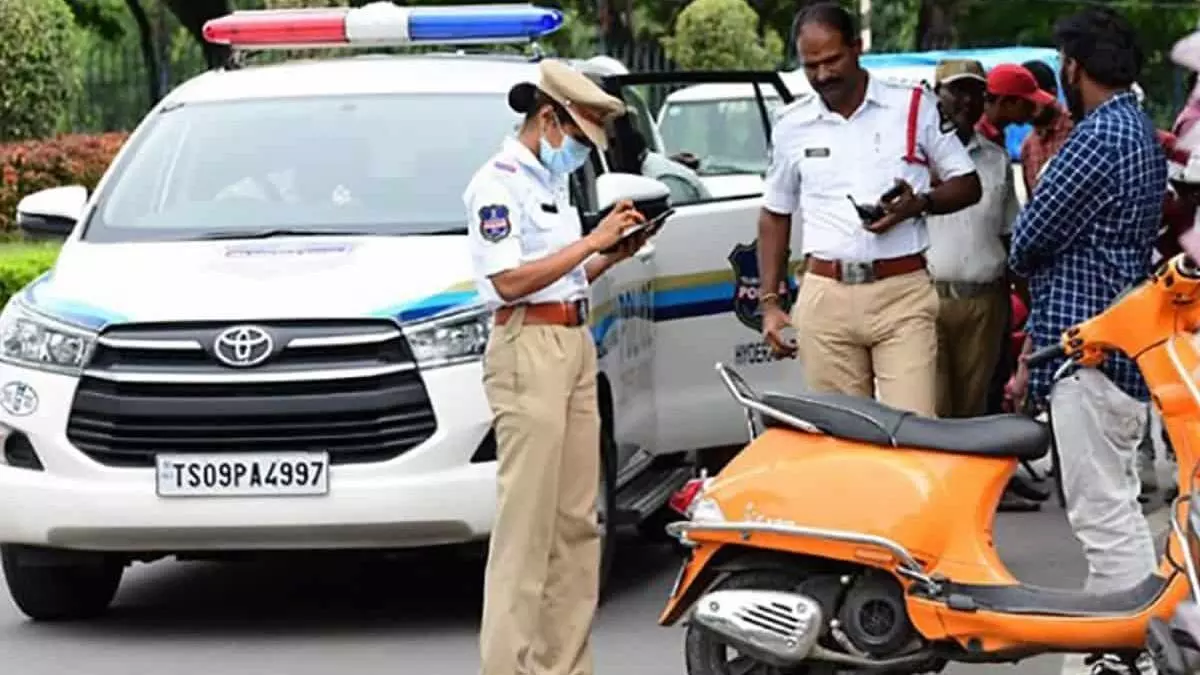
File Photo
Hyderabad: In a major relief for those commuting by road, the High Court on Tuesday ordered Telangana police not to stop and force citizens to pay pending traffic challans.
Court process must be followed for collecting traffic fines
Citizens have the choice to pay the challan and if the police want to take action, then due process (court notice, etc.) must be followed, the court ruled.
The court also stated that the police can’t take coercive steps such as snatching/confiscating keys to force immediate payment of pending traffic challans.
Citizens may choose to pay fines voluntarily
The Telangana High Court Single Bench, comprising Justice NV Shravan Kumar, issued a directive on Tuesday while hearing two writ petitions filed by a resident of Secunderabad, V Raghavendra Chary, challenging the enforcement mechanisms of the Hyderabad Traffic Police.
Justice NV Shravan Kumar clarified that while citizens may choose to pay their fines voluntarily, any enforcement action by the police must strictly follow the due process of law, including the issuance of formal court notices.
The court order has come as a major relief for thousands of daily commuters and two-wheeler riders.
Earlier, a writ petition challenging the Telangana Police practice of stopping vehicles and forcing motorists to clear pending traffic challans on the spot was heard by the High Court. Then, Justice Madhavi Devi issued notice to the Home Department and sought a detailed reply within four weeks.
The petition was filed by V Raghavendra Chary, questioning the legality of several traffic enforcement methods being followed by the Traffic and Law and Order Police.
Petitioner’s vehicle booked only through mobile phone photos
The petitioner had moved the court to declare a specific challan issued on March 17, 2025, for ‘triple riding’ as arbitrary and illegal, noting that the fine of Rs 1,200 was imposed without specifying the legal provision violated.
The petitioner informed the court that three traffic challans were imposed on his vehicle based only on photographs taken through mobile phones by Hyderabad Traffic Police personnel.
He challenged the validity of such evidence, stating that personal mobile phones, hand cams and non-certified devices cannot be used for legal enforcement.
What are the rules regarding imposing traffic challans?
The petitioner’s counsel, Vijay Gopal, argued that such penalties are contrary to Section 128 read with Section 177 of the Motor Vehicles Act, 1988, and Rule 167A(6) of the Central Motor Vehicle Rules, 1989.
It was contended that the Hyderabad Traffic Police must issue challans in accordance with the 1988 Act rather than the 2019 amendments, as the state had not fully adopted the revised penalty structures.
Only government-approved and certified surveillance cameras are permitted for recording traffic violations, the petitioner argued.
The petitioner further sought a direction for the police to rectify the e-challan system to ensure transparency and legal compliance.
‘Police cannot decide penalty, only courts can’
A major argument in the writ is that police personnel are illegally deciding the penalty amounts and collecting money from motorists without judicial oversight.
The petitioner contended that deciding punishment falls exclusively within the jurisdiction of the Judicial Magistrate and not with field-level personnel such as constables, home guards, sub-inspectors or circle inspectors.
The petition emphasised the ‘Separation of Powers’ doctrine, asserting that only a court of law has the mandate to decide the quantum of fines or imprisonment under Section 208 of the Motor Vehicles Act and the relevant Central Motor Vehicle Rules.
GO 108 of 2011 termed illegal and unconstitutional
The writ petition also challenges Government Order (GO) No. 108 of 2011, issued by the Transport Department, which authorises police to stop vehicles and collect compound penalties from the public.
The petitioner claimed that the GO is illegal, unconstitutional and violative of fundamental rights, as it allows the police to exercise powers that lie with the judiciary. The petitioner also claimed that the GO violates the ‘Doctrine of Repugnancy’ by contradicting the Central Motor Vehicles Act.
Earlier challenge on excessive fines referred
It was further submitted that the petitioner had earlier approached the court challenging the imposition of excessive and arbitrary traffic challan amounts on citizens, alleging that penalties were being imposed without proper application of law.
‘Civil society should not accept violation of laws’
Speaking to NewsMeter, advocate Vijay Gopal, appearing for the petitioner, made sharp submissions during the hearing.
“The Telangana Police have been violating laws and collecting money from citizens for decades, which civil society should not accept anymore. Who deserves what punishment must be decided by a Judge in a court of law, not by a constable, home guard, SI or CI,” he argued.
He further alleged, “Using mobile phones to click photos all day and selectively targeting middle-class two-wheeler riders has become the only visible form of law enforcement.”


