Hyderabad: Telangana amends building permission rules, makes TDR mandatory for high-rise constructions
The amended rules apply across 300 divisions within the existing GHMC limits, extending up to the ORR, officially notified as the Telangana Core Urban Region (TCUR)
By - Sistla Dakshina Murthy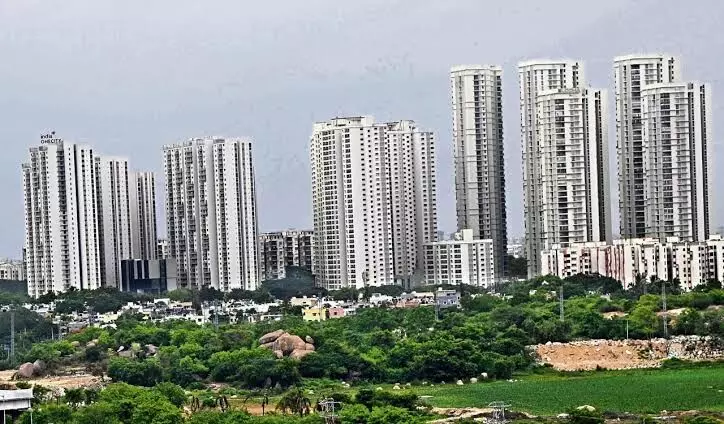
Representational Image
Hyderabad: Telangana government has amended building permission rules to make Transferable Development Rights (TDR) mandatory for high-rise constructions in Hyderabad’s Core Urban Region (CUR), covering the Greater Hyderabad limits up to the Outer Ring Road (ORR).
The new norms came into force with the issuance of GO No. 16 by the Municipal Administration Department on Friday.
Under the revised rules, developers constructing buildings beyond 10 floors will have to pay 10% fee of the built-up area, from the 11th floor to the top floor, in the form of TDR.
The government has directed civic and planning bodies, including Greater Hyderabad Municipal Corporation and Hyderabad Metropolitan Development Authority, to implement the amendments with immediate effect.
Higher TDR for Land Acquisition near water bodies
To facilitate the protection and development of lakes and rivers, the government has laid down enhanced TDR compensation for acquiring patta lands located within water bodies and their regulated zones.
If development agencies need to take over such lands, compensation will be provided as follows:
200% TDR for lands within the Full Tank Level (FTL).
300% TDR for lands in the buffer zone.
400% TDR if lands beyond the buffer zone also need to be acquired.
These norms will apply equally to lakes and rivers. Development works may be undertaken by agencies such as Musi Riverfront Development Corporation Ltd, GHMC, and HMDA.
Key provisions of the New Rules
Applications involving land extent exceeding one acre for TDR issuance must be referred to the State Government for scrutiny.
Landowners who voluntarily hand over lands in lakes or river areas will be eligible for relaxations in setbacks and height restrictions for projects undertaken by implementing agencies.
For buildings exceeding 10 storeys, developers must pay TDR equivalent to 10% of the total built-up area from the 11th floor onwards.
What is TDR and Why the Change?
TDR is a mechanism where landowners are compensated for land acquisition not in cash, but through development rights that can be used or traded elsewhere. In Greater Hyderabad, TDR has been in use for over a decade, with certificates worth more than Rs 10,000 crore issued in the past.
However, an oversupply of TDR certificates led to a sharp fall in market prices, discouraging landowners from accepting TDR in recent years and stalling land acquisition for roads, lake rejuvenation, and the Musi riverfront project.
Most owners began insisting on cash compensation, creating hurdles for public projects. By making TDR compulsory for high-rise buildings, the government aims to increase demand, stabilise its value, and resume land acquisition through TDR, thereby accelerating infrastructure development while protecting water bodies.
Area of Applicability
The amended rules apply across 300 divisions within the existing GHMC limits, extending up to the ORR, officially notified as the Telangana Core Urban Region (TCUR).
The government believes the new framework will strike a balance between urban growth, environmental protection, and faster execution of public infrastructure projects.


