Musi rejuvenation must for Hyderabad’s future, final plan by March 31: CM Revanth in Assembly
CM Revanth said the Musi project is not a cosmetic riverfront initiative but a long-overdue response to decades of pollution, encroachments and unplanned urbanisation
By - Sistla Dakshina Murthy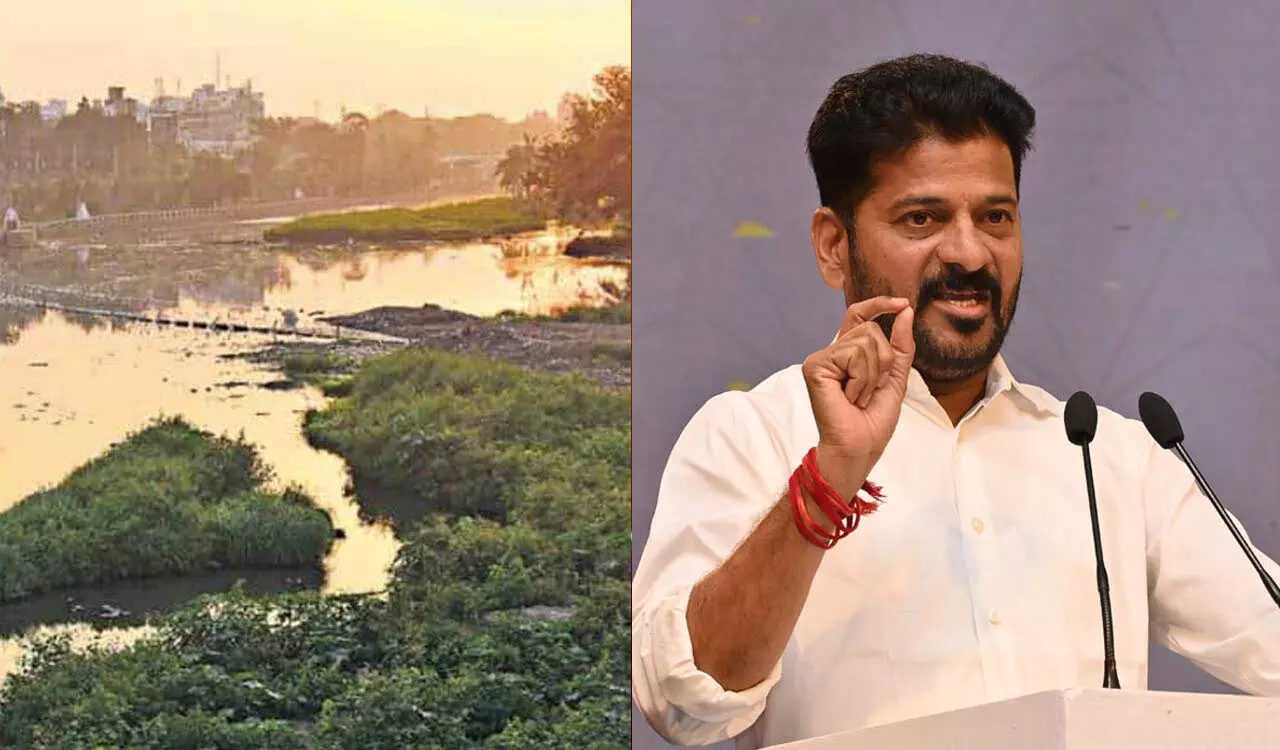
Musi rejuvenation must for Hyderabad’s future, final plan by March 31: CM Revanth in Assembly
Hyderabad: Chief Minister A Revanth Reddy, on the second day of the Telangana Assembly Session, made it clear that rejuvenation of the Musi River is unavoidable and critical to Hyderabad’s future.
He announced that estimations for the Musi Rejuvenation Project will be finalised by March 31 and the works will be started by inviting tenders immediately.
Addressing an intense debate in the House, he said the project would be executed in a systematic, scientific and transparent manner, with full rehabilitation and livelihood support for those affected.
Correcting decades of environmental neglect
CM Revanth said the Musi project is not a cosmetic riverfront initiative but a long-overdue response to decades of pollution, encroachments and unplanned urbanisation.
He alleged that earlier governments failed to protect water bodies, allowing untreated sewage and illegal constructions to destroy the river ecosystem.
“This injustice cannot continue. Cleaning Musi is about public health, water security and environmental responsibility,” he told the House.
Musi’s course and the Gandhi Sarovar rationale
Explaining the river’s geography, the Chief Minister said Musi originates at Ananthagiri and flows nearly 240 km till Vadapally. The Isa and Musa streams merge near Bapu Ghat, making it a natural location for the Gandhi Sarovar project.
“The Central government has also given its approval for the development of Gandhi Sarovar under the Musi project,” he informed the Assembly.
He said months of reviews were held with officials and experts, and the rejuvenation is being planned in phased stretches using scientific methods.
Pollution burden on downstream districts in Nalgonda
The Chief Minister said residents of downstream areas, particularly in Nalgonda district, are the worst sufferers due to Musi pollution. Untreated sewage has turned lives miserable, he said, calling it a humanitarian and environmental crisis.
To address this, plans are underway to rejuvenate the Gandipet–Vikarabad stretch, and Godavari water will be brought into the Musi basin within two years to improve flow and water quality.
“A permanent solution to the Musi pollution will be done by diverting the Godavari waters. We are planning to utilise 15 TMC of the 20 TMC for drinking water needs and 5 TMC to maintain a continuous flow of clean water in the Musi River,” the CM said.
Encroachments, farmhouses and enforcement
CM Revanth alleged that influential persons have built farmhouses in Gandipet and illegally diverted drainage into the lake. He said strict action was taken by demolishing illegal drainage lines.
“Strict action was already taken on the pollution of Osman Sagar and Himayat Sagar reservoirs through drainage from the farmhouses of the influential families,” the CM said.
He also claimed that those whose encroachments in Gandipet and Moinabad are set for removal spent huge sums to malign him on social media, but asserted that the government would not be deterred from protecting public water sources.
The CM also detailed the government plan to construct a 55-km elevated corridor from Gandipet to Gourella.
Learning from national and global models
Drawing parallels with other river projects, the Chief Minister cited the Sabarmati riverfront in Gujarat, the Ganga cleaning programme in Uttar Pradesh and ongoing efforts on the Yamuna in Delhi.
He said river rejuvenation often involves tough decisions, including relocation, but is essential for long-term urban sustainability. Officials, he added, studied riverfront models in cities such as London, Singapore, South Korea, Japan and Germany to balance ecology with development.
In Gujarat, 60,000 families were relocated during the Sabarmati River cleanup. The Ganges River was also cleaned up, and a riverfront was developed in Uttar Pradesh. BJP leaders promoted these structures as a sign of development, the Chief Minister said. We never opposed these projects, the CM said.
Works underway, urban pressures highlighted
Works near Mir Alam Bridge have already begun as part of the Musi programme. CM Revanth said the objective is to restore the Old City as the ‘Original City’ with modern infrastructure.
Warning of rapid urbanisation, he noted that nearly 1.34 crore people already live in Hyderabad and projected that up to 75 per cent of Telangana’s population could migrate to the capital in the next two decades, making water security non-negotiable.
The CM strongly objected to being called a ‘real estate broker’. “Real estate is also an industry. Similar criticisms were made when the Hitech City was developed,” he said.
CM promises rehabilitation
The Chief Minister assured that no affected family or trader would be abandoned. Displaced residents will be rehabilitated in newly developed colonies, while traders and workers who lose livelihoods will be provided with facilities and opportunities to restart businesses.
Funding, timeline and transparency
CM Revanth said cost estimates for rejuvenating a 21-km stretch of Musi will be finalised within three months. He disclosed that the Asian Development Bank has agreed to provide a Rs 4,100-crore loan and that necessary approvals have been obtained from the Centre.
“All details will be placed in the public domain within four to five days,” he said, stressing transparency and accountability.
DPR, Assembly oversight and inclusive planning
Once the Detailed Project Report (DPR) is completed, it will be tabled before the Telangana Legislative Assembly for discussion.
CM Reddy said suggestions from MLAs and floor leaders would be incorporated, and Musi-region legislators would be sent on foreign study tours to give informed inputs.
He also announced plans to develop cultural and religious landmarks along the Musi corridor, alongside ecological restoration.
Appeal for constructive politics
Concluding his address, the Chief Minister appealed for constructive debate and reduced hostility, asking whether Musi should be restored or left polluted. He asserted that Musi rejuvenation would stand as a historic urban transformation project carried out in the larger public interest.


