Interview: Sanitation to infra, the first Cyberabad Municipal Commissioner IAS Srijana plans big
In conversation with NewsMeter, Commissioner G Srijana shared her vision and priorities.
By - Rajeswari Parasa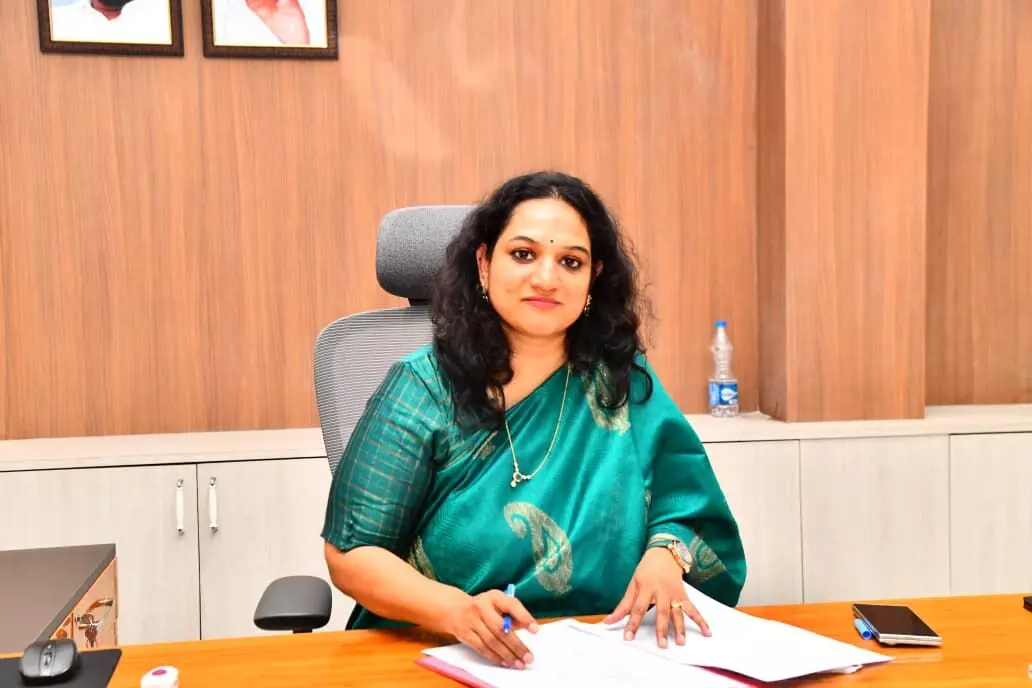
Hyderabad: 100% source collection of garbage, eradicating mosquito and stray menace and infrastructure upgrade are amongst top priorities for the IAS officer Srijana Gummalla, the newly appointed Municipal Commissioner for Cyberabad.
With the historic trifurcation of city’s civic body, the Cyberabad Municipial Corporation (CMC) was formed as one distinct civic body.
In conversation with NewsMeter, Commissioner G Srijana shared her vision and priorities. The officer brings a rich administrative experience to the table. She began her career as Sub Collector of Vijayawada, then served as Joint Collector of Vizag.
She went on to head the Greater Visakhapatnam Municipal Corporation. Her tenure in Andhra Pradesh also included serving as Commissioner of the Industries Department and as district Collector for both Kurnool and NTR districts.
After she moved to Telangana in 2024, she also held the position of Commissioner of Panchayat Raj and Rural Development, Telangana and served as Additional Commissioner - Greater Hyderabad Municipal Corporation(GHMC).
G Srijana taking charge as the first Commissioner of Cyberabad Municipal Corporation
Here are the excerpts from the interview:
NM: With the formation of the new corporation, what are your top priorities?
Srijana: Sanitation first will be at the top of the priority list. I believe the corporation's first mandate is to give a respectable life to any citizen, poor, rich, it doesn't matter. A respectable life means first having a clean environment around. So, sanitation will be a priority always.
Then, of course, bringing infrastructure closer is my other priority. I have a very interesting mix of areas in my jurisdiction. Cyberabad is the IT capital of the country, where you see a really plush environment. I also have places that are newly merged, like Quthbullapur and others, where infrastructure is still a dream.
So, I need to really balance the needs of these two varied areas. In Quthbullapur and the other merged areas, I’ll really have to improve road infrastructure, footpaths, street lights, parks, and a cleaner environment. Most of it is already there in the IT city.
However, here the needs would be different. They want a better AQI (Air Quality Index), more walkable streets, or less traffic congestion.
You really need to balance things. Just because I need to give a road in Quthbullapur doesn't mean I will not talk about AQI or a walkable street in Madhapur. Both are important to me. I will have to plan my resources and energies accordingly.
NM: Since the IT zone is already rich and built, while other zones need development, as you said. How best will the corporations use the revenue since Cyberabad is the richest municipal body?
Srijana: Yes, it's not necessarily that revenue coming from one place has to be spent there only. The funds can be utilised according to need. It is a common pool.
NM: The Cyberabad zone records the highest tax returns. Is there any policy to pump revenue directly into local infrastructure to ensure the amenities match the economic output?
Srijana: As we know, after trifurcation, this will be one of the most revenue-generating corporations. Because of the property tax revenue or building plans, the revenue is a little more. So, funds-wise, I don't think there will be a dearth.
However, there is a need for planned development.And for much bigger projects, like H-City, we would need the help of the state government, where probably our own resources might not be enough.
So state government’s help or some Government of India projects will have to be brought in to improve the quality of life.
NM: May we know how much property tax is expected?
Srijana: With different resources together, it should be about ₹1400 to ₹1500 crore per annum.
NM: Are resources still being shared with the other corporations, or is it standalone?
Srijana: We are yet to divide the resources between the three corporations. And of course, the loans, liabilities, and assets, everything has to be divided. There is a committee formed to finalise it. Based on its report, we will divide our assets and liabilities.
NM: This area is being called a concrete jungle due to recent developments/constructions leaving little space. Do you have plans to increase biodiversity, rainwater harvesting, or groundwater levels?
Srijana: Very important. First thing, because of concretization, what has happened is traffic congestion. People are vexed or sometimes very frustrated with the congestion. So easing that is a greater priority. It's not always about widening roads; we can give more underpasses, more flyovers. It's more about flow management. I need to work in close coordination with the police on this issue.
Having said this, it is also important to give them green and recreational spaces. There are nice lakes around. If I can make them pollution-free and make them a nice place to hang out, that improves the quality of life. It’s not always about monetization; it's about the value the asset can bring to the quality of life.
We have a lot of potential. In this concrete jungle, you can have an oasis. For example, Durgam Cheruvu really looks like an oasis of hope to me. You have tall skyscrapers around, but people really want to go there and spend time, and you can build economic zones and entertainment zones around it.
NM: You recently inspected Neknampur Lake. Many lakes seem to have sewage issues?
Srijana: Yes, I have been inspecting lakes recently. These are all hidden gems. We probably don't even know the value of preserving them.
I was very happy to find out that Kudikunta Lake has been restored. The AQI, which was about 400 or 350 before restoration, is now 21 to 25. Just because you diverted the sewerage, made that lake pollution-free, and added some plants, the AQI dramatically fell. Imagine the good that it is doing for the health of the people living around it. That is an opportunity cost.
Earlier, the place had been converted into a sewage dump yard. My role is to sensitize the public. All those things were rejuvenated by private people only. Cyberabad has people who are active, outspoken, and willing to contribute. We need to act like a bridge.
NM: The mosquito menace is a major concern in gated communities. Any major plans for this?
Srijana: See, mosquitoes breed only in fresh water. They don't breed in a nala or polluted water. The dengue and malaria-causing anopheles mosquito breeds only in potable, fresh water. Many times, this is in our houses.
While it is important to ensure there is no water stagnation and carry out anti-larval operations and spraying, I must work with people. The mosquito doesn't travel more than 300 meters. So it is not coming from a distant lake; it is likely bred in the vicinity or inside the house.
Meanwhile, we need to remove the water hyacinth, divert sewage, and ensure aeration so there is no stagnation. But I also appeal to people to look into their surroundings.
A mosquito bred in my house might not bite me, but it will go 300 meters to another house. We need to sensitize people on how to identify and eliminate breeding sources.
During a Sanitation and Entomology review
NM: What are your plans regarding potholes and road maintenance for the upcoming rainy season?
Srijana: For monsoon preparedness, we have already started desilting of nalas. Last year, it was done a little late, which caused flooding. We have started early this time.
Thankfully, we also got the CRMP (Comprehensive Road Maintenance Project) sanctioned yesterday in the Cabinet. Cleaning, sweeping, pothole management, and footpath management will be done very quickly. ₹6000 crore was approved yesterday for the three corporations. In one or two months, we should see things rolling.
NM: Garbage segregation and street dogs are interlinked issues. What is the plan?
Srijana: Garbage collection itself is a challenge here. What I have learned is that garbage collection does not happen daily. So my first challenge is to ensure 100% source collection every day. My first duty is to ensure I send my person every day.
We are revising our SOPs (Standard Operating Procedures). 100% source collection is the first step. The Government of India has also issued new Municipal Solid Waste guidelines. That has stricter norms and penal provisions, which is an opportunity for us to revise our SOPs.
The street dog menace and garbage are interlinked. If garbage is on the road, animals breed there. Not just dogs, but pigs and rats too. Until we handle garbage collection, this will happen.
Onsite, officer Srijana inspects Sanitation
NM: There are many unregulated food stalls. There have been concerns about hygiene and adulteration. How do you plan to tackle this?
Srijana: It is very unregulated. It is part of our agenda. We need to balance livelihood, also. I don't want to hit at somebody's livelihood, but I want to give them certain regulations.
Removing them is easy; I just use my authority and bulldoze. But I am hitting at someone's livelihood. The Act is clear: I need to create a vending zone and shift them there. If I don't give him a vending zone, that is a reason for me to wait. But after I find a place, if he doesn't go, then I won't wait.
The larger good of the community is more important than the rights of an individual. We don't want to inconvenience the vendor, but we need to regulate them properly and give them licenses so they fall into our regulatory framework.
Officer Srijana Interacting with a street vendor
NM: For the clarity of citizens, what is the exact geographical extent of the new Cyberabad Municipal Corporation?
Srijana: I have about 630 to 637 square kilometers. It brings together three critical zones. These are Serilingampally with five circles, Kukatpally with four circles, and Quthbullapur with seven circles. Together, they comprise around 76 wards. The zones and circles are already established. What I am establishing now is only a head office. I have been allotted 150 people in the head office temporarily.
Cyberabad Municipal Corporation map
NM: Are the resources like dump yards and animal birth control centers being managed together with other civic bodies or independently?
Srijana: They are currently shared. There is a committee formed by the Chief Secretary to decide how we distribute our assets, liabilities, and human resources. We are aiming for April 1, when we will be completely independent. We are administratively independent now, but our finances and assets are being sorted to ensure no legacy issues remain.
Meet your Commissioner:
An interaction with citizens during Prajavani
Residents will have an opportunity to meet the officer every Monday as part of Prajavani from 10:30 am to 1:30 pm at the Office of the Commissioner, National Academy of Construction (NAC) building.


