‘Solutions, not conflicts’: CM Revanth calls for dialogue with AP on long-standing water disputes
CM Revanth made it clear that the Congress-led government has no intention of politicising the water crisis
By - Newsmeter Network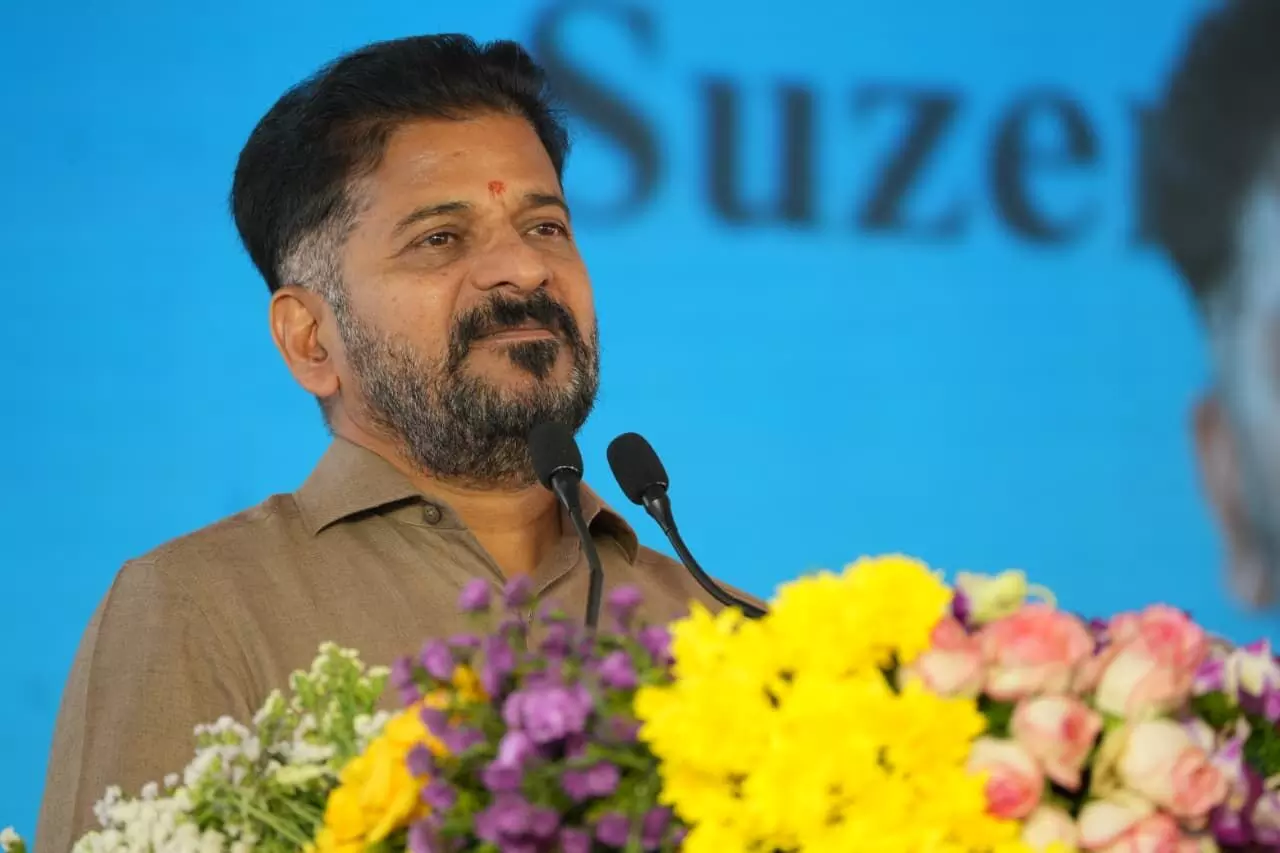
CM Revanth announces new healthcare policy for Telangana, welfare push for transgenders, senior citizens
Hyderabad: Initiating an interstate co-operation, Chief Minister A Revanth Reddy has extended an olive branch to Andhra Pradesh, calling for an amicable resolution to long-standing water disputes.
Speaking at the inauguration of a manufacturing unit in Hyderabad, the Chief Minister emphasised that his government prioritises ‘solutions over conflicts’ and ‘water over disputes,’ signalling a strategic shift toward diplomatic engagement.
CM Revanth’s appeal for cooperation
CM Revanth made it clear that the Congress-led government has no intention of politicising the water crisis. Instead, he appealed to all political parties to transcend narrow interests for the sake of farmers and the public of both states.
“If asked whether Telangana needs a dispute or water, I would choose water. If asked whether we need a conflict or a solution, I would choose a solution,” the CM stated.
Key highlights of the CM’s address
1. Direct appeal to AP CM: Revanth Reddy specifically addressed Andhra Pradesh Chief Minister N Chandrababu Naidu, urging him not to create hurdles for projects on the Krishna River that were conceptualised in the undivided state.
2. Financial impact: He noted that ‘obstacles’ created by the neighbouring state have led the Central Government to withhold funds, placing an immense financial burden on Telangana.
3. Port connectivity: The CM highlighted that mutual cooperation is essential not just for water, but for Telangana to gain critical port connectivity through Andhra Pradesh.
4. Regional harmony: Beyond Andhra Pradesh, the CM expressed a desire for friendly ties and mutual cooperation with all neighbouring states, including Karnataka, Tamil Nadu and Maharashtra.
The Chief Minister concluded by reiterating that discussions with neighbouring states will continue, driven by the interests of the people rather than political gain.
What is the AP-Telangana water dispute about?
The water conflict between Andhra Pradesh and Telangana is a legacy of the 2014 state bifurcation, rooted in the sharing of the Krishna and Godavari rivers.
1. The Krishna River Conflict
The primary bone of contention is the sharing of 811 TMC (Thousand Million Cubic feet) of water. Following bifurcation, an ad-hoc arrangement allocated 66 per cent (512 TMC) to Andhra Pradesh and 34 per cent (299 TMC) to Telangana.
Telangana’s stand: The state argues this ratio is unfair as the majority of the river basin lies within its territory. They are demanding a share of at least 50 per cent or more (roughly 500+ TMC).
The projects: Projects like the Palamuru-Rangareddy Lift Irrigation Scheme (PRLIS) in Telangana and the Rayalaseema Lift Irrigation Scheme (RLIS) in Andhra Pradesh are frequent flashpoints, with both states accusing each other of ‘illegal’ constructions without Apex Council approval.
2. Operational Control
Tensions often flare up at the Srisailam and Nagarjuna Sagar dams. In late 2023, the situation escalated when the Central Government had to deploy paramilitary forces to take control of the Nagarjuna Sagar dam after a physical standoff between the police forces of both states over the opening of the head regulators.
3. The Role of the Boards
Under the AP Reorganisation Act, the Krishna River Management Board (KRMB) and Godavari River Management Board (GRMB) were established to oversee water sharing. However, disputes persist over the ‘jurisdiction’ of these boards and the ‘operational protocols’ for power generation versus irrigation.


