Why wattle trees have become an environmental issue in Nilgiris
The wattle trees introduced for their tannin-rich bark have become an environmental issue in the Western Ghats, especially the Nilgiris in India
By - Beyniaz Edulji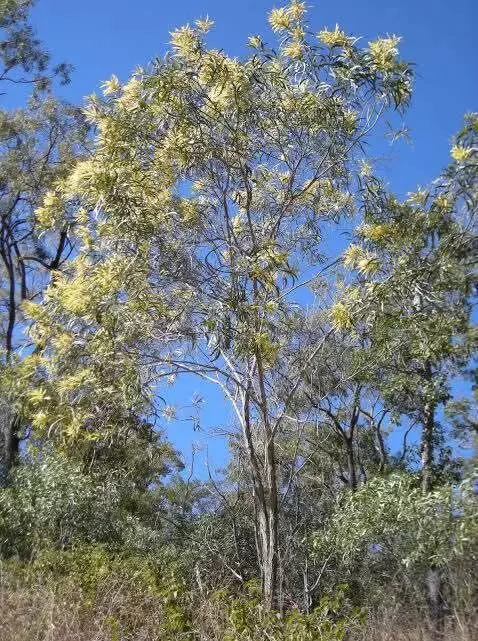
Wattle trees introduced for their tannin-rich bark have become an environmental issue in the Western Ghats, especially the Nilgiris in India
Hyderabad: Invasive wattle trees are mostly Acacia mearnsii or black wattle. The wattle trees, introduced for their tannin-rich bark, have become an environmental issue in the Western Ghats, especially the Nilgiris, where they displace native grasslands and shola forests. Forest Departments in Kerala and Tamil Nadu have sought permission to eradicate these trees, which are among the 100 worst invasive alien species in the world..
Origin and History
Wattle or Acacias have been used all over the world for a very long time. Ancient Egyptians used acacia as one of their major timbers; they even used this very hard wood to clamp shut their mummy coffins. They were building boats and furniture out of wattles in 3,000 B.C. Roman buildings in North Africa, and structures unearthed in India have all been found to have preserved acacia timbers from 2,000 years ago.
Napoleon's wife, Josephine, was a keen horticulturalist. Josephine's efforts in her beloved garden at Malmaison outside Paris ensured the introduction of many Australian plants to France. The French ship Recherche visited Tasmania in 1792. On board was a gardener called Felix Delahaye, who later became the Empress Josephine's head gardener. Together, Josephine and Felix planted wattles in France from seeds gathered in Australia, 16,000 km away. Josephine was part of great botanical discoveries.
The British Army planted Blackwood (Acacia melanoxylon) wattle trees in the highlands of India in the 1840s to use as a quick-growing fuel. Today, the same Blackwood trees provide shade on Indian tea estates. Australian acacias' adaptability to different soils and rapid growth rate have made them popular for planting in many countries such as South Africa, Indonesia, Sri Lanka, India, China, Portugal, America, and Brazil.
Leather processing
Black wattle (Acacia mearnsii) was introduced in India from Australia by the British in the early 1900s for leather processing. They thrived in the cooler, moist climate of the Western Ghats and have spread into native grasslands and shola forests, often displacing native species.
Environmental impact
The spread of wattle trees has led to the loss of native vegetation, reduced water flow in streams, and suppressed native grasses and wildflowers. Due to its invasive nature, forest departments in states like Kerala and Tamil Nadu have begun pilot programs to remove wattles and restore the native habitats.
PampadumShola
At elevations between 1,900 and 2,300 metres, Pampadum Shola is one of the world’s oldest mountain systems, home to many distinct flora and fauna. In Kerala's Western Ghats, Pampadum Shola National Park is undergoing a remarkable transformation. Once dominated by invasive Australian wattles, the park's grasslands are being restored, reviving streams and native species. This highlights the importance of understanding ecosystems, as removing trees can sometimes be more beneficial than planting them.
In Kerala’s Western Ghats, until a few years ago, there used to be rows of alien trees, but now there are open meadows and low, wind-swept grasslands. The slopes of Pattiankal and Pazhathottam, once suffocated under Australian wattles, are now breathing again. The streams that had disappeared for decades have begun to trickle again. It is ecological redemption.
Fragile jewel of the Ghats
At elevations between 1,900 and 2,300 metres, Pampadum Shola is the southernmost shola or grasslands in the Western Ghats, one of the world’s oldest mountain systems, predating the Himalayas. Here evolved distinct flora and fauna like the Nilgiri marten, Kerala laughing thrush, black-and-orange flycatcher, and a dozen orchids and tree ferns unique to this area. The grasslands act as natural sponges, capturing and slowly releasing rainwater into the headstreams of the Pambar and Vaigai rivers that sustain Tamil Nadu’s dry plains.
For local farmers in Vattavada and Koviloor, Pampadum is not wilderness but a watershed. The sholas temper their climate and feed their vegetable fields. When the grasslands disappear, the water also goesbut after the forest people cleared the wattles, water is flowing even in summer.
Good intentions
Wattles being uprooted today were once planted by the same institution now leading their removal - the Kerala Forest Department. Introduced by the British in the early 1900s, Acacia mearnsii (black wattle) was prized for its tannin-rich bark, used in leather processing. It thrived in the high, moist plateaus of the Western Ghats, spreading rapidly into wild landscapes. To colonial foresters, the native grasslands seemed barren wastelands waiting to be improved with trees.
Through the 1960s and 70s, forestry programs filled the open meadows of the High Ranges with wattle, eucalyptus, and pine, all species that grew fast and looked green but actually strangled everything else. Beneath their dark canopies, native grasses withered. The soil hardened and lost porosity; streams that once flowed year-round turned seasonal. Invasive shade suppressed herbs and wildflowers, displacing pollinators and grazing fauna. The grasslands, critical hydrological engines of the mountains, soon began to die.
By the 1990s, foresters realized the magnitude of the error. The green plantations were ecologically sterile, their roots choking the hillsides and depleting water tables.
Forest Fire
In March 2015, a forest fire burnt through nearly 40 acres of wattle-dominated slopes inside Pampadum Shola. Experts soon realized that if wattles were left to recolonize, the original grasslands would be taken over by these invasive trees.
Between 2020 and 2024, the Forest department cleared roughly 500 acres of wattle across four key sites-Pattiankal, Pazhathottam, Thamburan Shola, and Bandar. Workers manually uprooted stumps, used felled trunks as contour bunds to control erosion, and sowed native grass seeds collected from nearby meadows. In the newly exposed earth, the first shoots of Chrysopogon and Eriochrysis grass species reappeared. Gradually, open meadows began to reclaim their space.
Ecological impact
The shola–grassland mosaic supports a vast range of species, many of them only found here. Under the dark, moisture-sapping canopy of wattle, these species vanished. Restoring grasslands reopens the ecological field for pollinators, reptiles, small mammals, and birds such as the Nilgiri pipit and the broad-tailed grassbird.
Grasslands are also critical to the hydrological balance. Their fibrous roots absorb rainfall, recharge aquifers, and ensure steady base flow in streams. Under wattles, the soil compacted and rainfall simply ran off, eroding hillsides and drying springs. The grasslands are true reservoirs as they hold the water that sustains both sholas and human settlements.
Early monitoring of cleared Pampadum plots confirms the science. Soil moisture has improved; infiltration rates are higher, and sightings of Nilgiri martens and small herbivores have increased. Springs that had vanished decades ago now bubble again.
Eco-Restoration
This ecological awakening began in 2021, when Kerala adopted the State Eco-Restoration Policy. Exotic plantations were formally identified as ecological threats, and the removal of invasive species — especially wattle and eucalyptus — from high-altitude ecosystems became a state priority.
The project’s phased restoration plan now covers 500 acres, with another 600 acres in the pipeline. The model is being studied for replication in other high-altitude protected areas like Eravikulam, Mathikettan Shola, and Silent Valley.
Slow and Painstaking work
Grassland restoration is slow and painstaking. Even if trees are cut, their roots sprout again unless you dig them out. Sometimes the process has to be repeated three or four times. Local youth, many from eco-development committees, have been trained in restoration techniques like root stumping, contour bunding, grass seeding, and erosion control. Wattle logs are stacked along slopes to check soil runoff; collected grass seeds are mixed with topsoil and manually sown before the monsoon. Wattle roots are persistent; without continuous follow-up, they resprout within months. Funding gaps could delay the next phase.
Global relevance
Black wattle is listed among the world’s 100 worst invasive alien species. Its removal is a conservation priority from South Africa to Brazil. Yet few places have attempted systematic, large-scale restoration of invaded grasslands. Kerala’s effort is thus being closely watched as a potential model for tropical montane restoration worldwide.
Good Results
Now bees and butterflies have started returning, and streams are flowing. The hills are coming back to life. At the recent Western Ghats Ecology Experts’ Conclave, scientists hailed Pampadum as India’s first living laboratory for de-plantation ecology. The project’s combination of manual clearance, community participation, and natural regeneration, without heavy mechanisation or chemical treatment, offers lessons for similar ecosystems across the Nilgiris, Palanis, and Anamalais.


