Hyderabad, Hong Kong students participate in international educational exchange programme on animal welfare
The International Educational Exchange Program was aimed at encouraging students to research issues related to animals, present their findings and engage in structured questioning
By - Beyniaz Edulji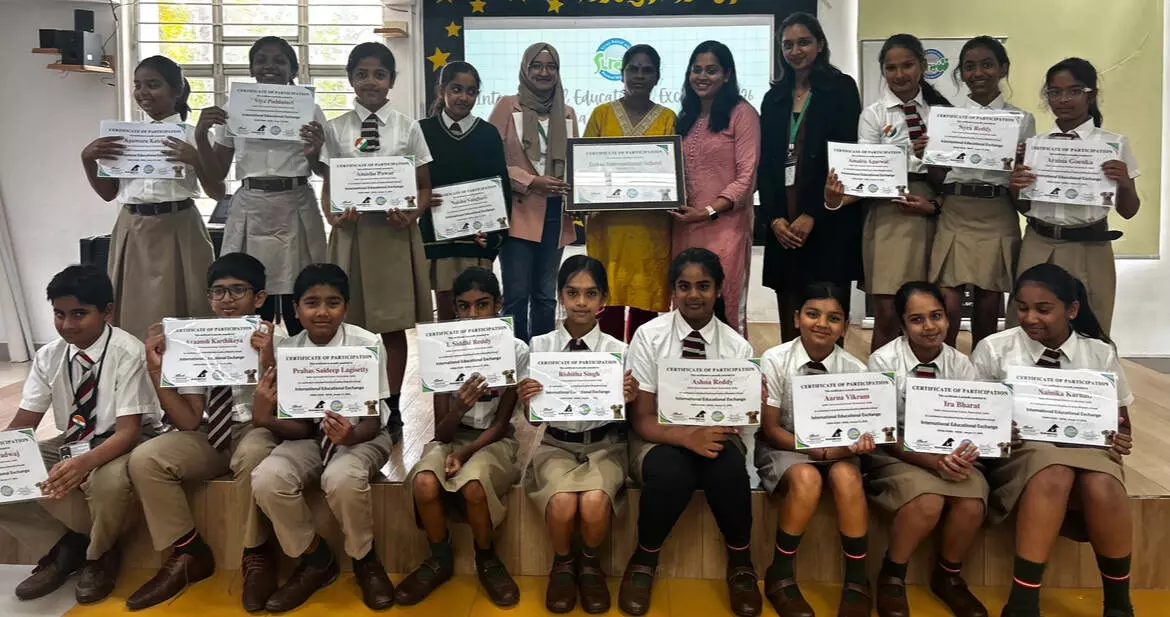
Hyderabad: A notable international academic exchange took place on January 27, where students from India and Hong Kong came together online to explore the theme of animal welfare.
The initiative, known as the International Educational Exchange Program, brought together diverse learning environments and demonstrated how education can act as a bridge between cultures while nurturing empathy and civic responsibility in young people.
What is the program about?
The International Educational Exchange Program was aimed at encouraging students to research issues related to animals, present their findings and engage in structured questioning.
The International Educational Exchange Program was jointly facilitated by Stray Relief and Animal Welfare (STRAW India), an animal welfare NGO that focuses on creating awareness about animal welfare issues through humane education and Animals Asia, Hong Kong.
The participating schools were Indus International School, Hyderabad, and Bishop Paschang Catholic School, Hong Kong. The exchange was coordinated by Asia for Animals, a coalition based in Hanoi, Vietnam.
Ethical considerations in using animals for commercial purposes
The exchange examined ethical considerations around commercial breeding and the importance of adopting companion animals.
It also highlighted scientific approaches to community dog management through vaccination and sterilisation and introduced students to key animal protection laws in India that aim to reduce cruelty and promote coexistence.
Link between education and civic responsibility
Participants shared perspectives on how animals are treated in their respective countries, how public opinions are shaped and how legal and cultural systems influence welfare outcomes.
The exchange allowed students to compare experiences, identify common challenges and reflect on the link between education, empathy and civic responsibility. The conversation revealed that even though specific policies differ, the underlying values that support humane treatment of animals are widely shared across both cultures.
To cultivate compassion and scientific reasoning
The timing of the exchange aligns with growing public interest in animal welfare in India, particularly in relation to community dogs.
With increased attention on policy, legislation and humane urban solutions, the program demonstrated that long-term progress also depends on early educational interventions that cultivate compassion, scientific reasoning and awareness of interconnected social issues.
The facilitators noted that learning about animal welfare through an intercultural lens helps students think beyond borders and recognise that the well-being of animals is linked to broader goals of public health, community safety and social harmony.
Reflecting on the experience, Tanveer, Humane Educator at STRAW India, commented, “Children from both the Indian school and the Hong Kong school prepared thoroughly and asked thoughtful questions to understand how each country addresses the issue of stray animals. One of the main purposes of this exchange is to enable students to learn more about their own country through comparison and reflection. When the Indus school students learned about recent cases of cruelty toward dogs in Telangana, they were shocked and expressed that we must learn to coexist with dogs who share this planet with us, rather than resort to violence.”
Organisers reported that the students engaged with maturity, curiosity and respect.
Discussions are underway regarding future exchanges and collaborative activities. The event demonstrated that international cooperation in education can nurture informed and empathetic citizens and contribute to creating safer and more compassionate societies for both animals and humans.


