Winged guests log in: Flamingos arrive in Hyderabad for winter sojourn
The migratory season for flamingos in the region is generally from December to March, with January often being the peak
By - Beyniaz Edulji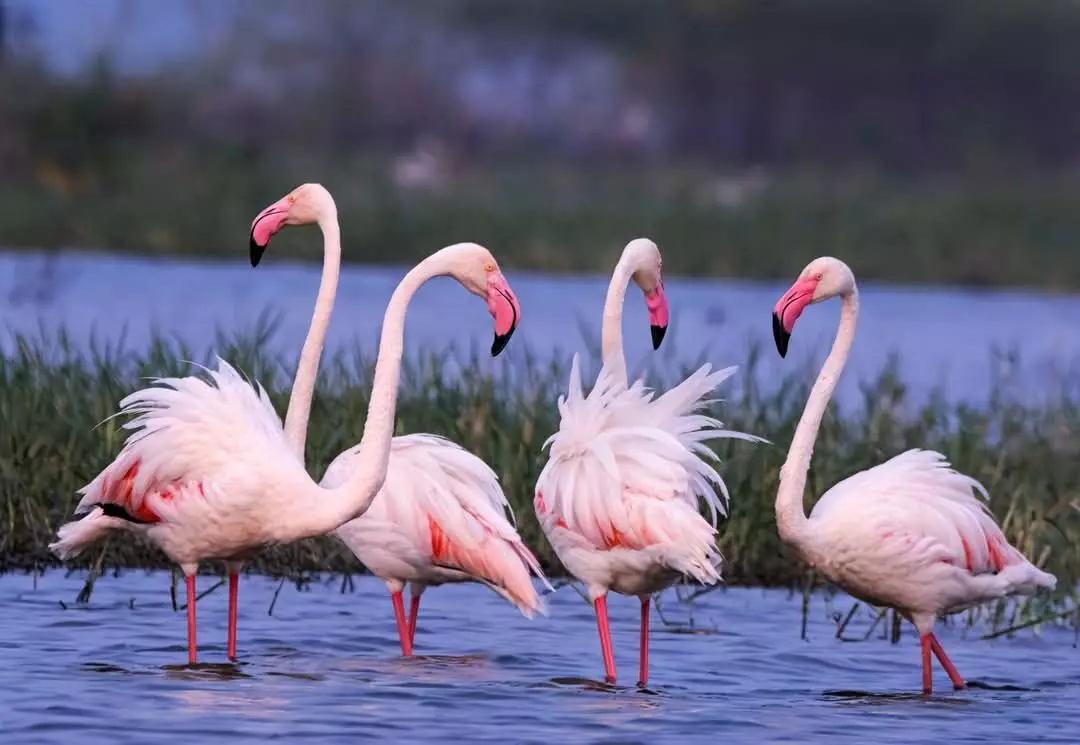
Winged guests log in: Flamingos arrive in Hyderabad for winter sojourn
Hyderabad: This week, bird watchers have started spotting Flamingos near Hyderabad. In winter, Flamingos can be sighted around Hyderabad. Kistareddypet Lake, Ameenpur Lake, and Pulicat Lake/Nelapattu along the Andhra Pradesh border are favorite places for them.
The migratory season for flamingos in the region is generally from December to March, with January often being the peak.
Where to Spot Flamingos
Kistareddypet Lake
This is a hidden gem near Hyderabad, popular for its peaceful environment and flamingo sightings, especially around sunrise and sunset.
Ameenpur Lake
Hyderabad's first Biodiversity Heritage Site, known for its birdlife, including flamingos during migration season.
Pulicat Lake/Nelapattu on AP Border
While technically in Andhra Pradesh (Tirupati District), it's a major spot and hosted the Flamingo Festival in January 2025, attracting a huge number of birds and visitors.
Live in Large Groups
Flamingos belong to the wading bird family and have tall, thin legs and pink or reddish feathers. They are native to parts of Africa, southern Europe, and South America, and call wetlands, shallow lakes, and other bodies of water their home. Flamingos love to live in large groups called colonies and feed on small crustaceans, algae, and tiny aquatic organisms. They use their bristle-like beaks to skim through water and filter food. Flamingos are also known for their elaborate courtship rituals that involve displaying and preening their feathers.
Flamingos in India
Flamingos are found across India, especially in winter, in saline and brackish wetlands like Sambhar Lake (Rajasthan), Rann of Kutch (Gujarat, the only nesting site), Chilika Lake (Odisha), Nal Sarovar (Gujarat), and coastal areas near Mumbai (Thane Creek), with major populations in Gujarat and Maharashtra, seen from November to May, offering stunning displays of pink flocks in shallow waters for feeding and breeding.
West Coast of India
In Winter, flamingos are seen along India’s west coast. Navi Mumbai transforms into a pink paradise as thousands of migratory flamingos arrive, creating one of the country’s most beautiful natural spectacles.
From November to May every year, flamingos travel from distant regions such as Iran and Gujarat to the rich wetlands of Mumbai’s coastline. The algae-filled waters of Thane Creek and its surrounding marshes offer good feeding grounds, drawing huge flocks of flamingos.
Thane Creek’s Flamingo Sanctuary in Airoli is the best location for viewing these beautiful birds. Surrounded by dense mangrove forests, the sanctuary also shelters hundreds of other bird species, fish, and marine life, making it a vital ecosystem and an exciting tourist attraction.
Flamingo nests are made of mud
A flamingo’s nest looks like a mini mud volcano, with room for one large egg. Flamingos are monogamous, and male and female flamingos both help to build the nest and incubate the egg. Flamingo chicks hatch with white-gray, downy feathers and straight bills. It takes several years for them to acquire their signature pink color and hook-shaped bills.
Why are Flamingos pink
Flamingos are pink because of what they eat. Many plants produce natural red, yellow, or orange pigments, called carotenoids. Carotenoids give carrots their orange color or turn ripe tomatoes red. They are also found in the microscopic algae that brine shrimp eat. As a flamingo feeds on algae and brine shrimp, its body metabolizes the pigments, turning its feathers pink.
Flamingos eat upside down
Flamingos are filter feeders (like Whales) and turn their heads upside down to eat. They eat algae, small seeds, tiny crustaceans like brine shrimp, fly larvae, and other plants and animals that live in shallow waters.
When it’s time to eat, a flamingo will place its head upside down in the water with its bill pointed at its feet. It then sweeps its head side-to-side, using its tongue to pump water in and out of its bill. Comb-like plates along the edge of the bill create a filter for water to rush out, while trapping food inside.
Flamboyance
A group of flamingos is called a flamboyance. Other collective nouns for flamingos include stand, colony, and pat.
Six species of Flamingos
There are six flamingo species. They are Caribbean flamingos, lesser, greater, James’s, Chilean, and Andean flamingos. Greater flamingos are found in parts of Africa, Asia, and Europe. They are the largest and tallest flamingo species.
Chilean, Andean, and James’s flamingos are found only in South America. Andean flamingos are the rarest of the six species, with fewer than 40,000 birds. Lesser flamingos are found in parts of Africa and southern Asia. They are the smallest flamingos and the most abundant. There are more than 2 million lesser flamingos brightening skies and shores with their pink plumage.


